
011
Introduction of the validated MACOCHA scoring system for assessing difficulty of intubation in critical care: An audit of intubation during the COVID-19 pandemic
011
011
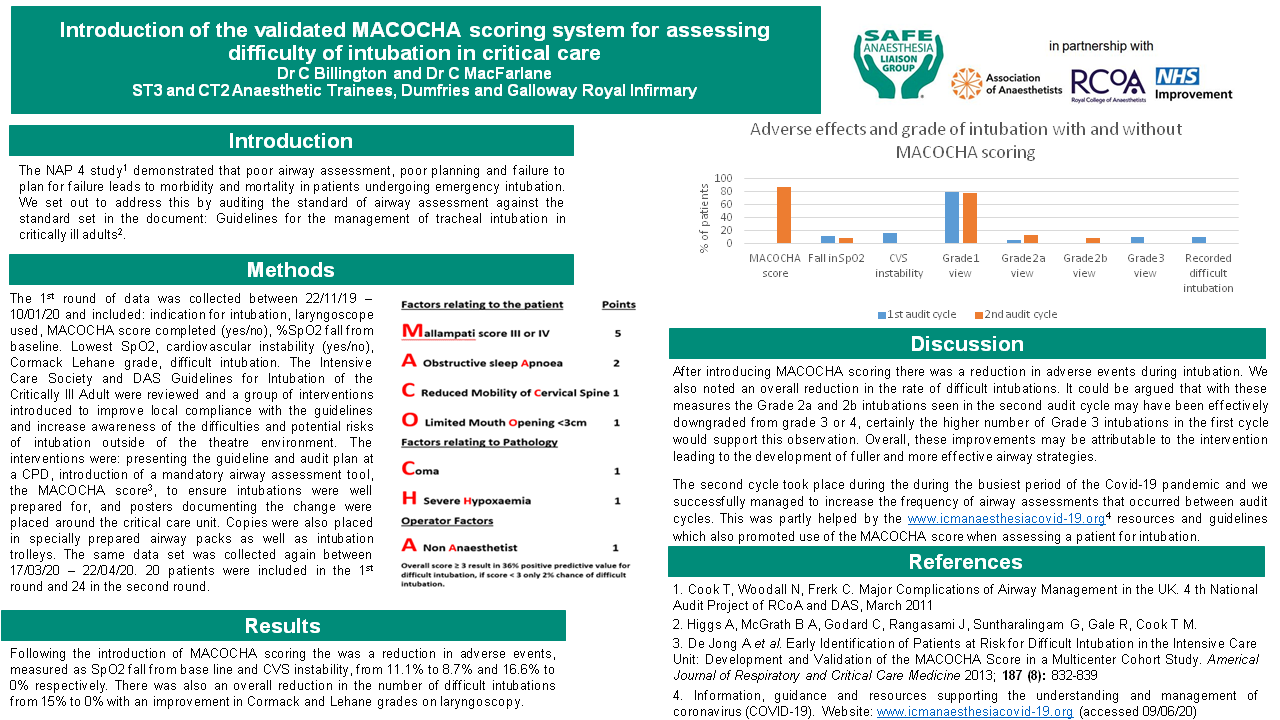
The NAP 4 study demonstrated that poor airway assessment, poor planning and failure to plan for failure leads to morbidity and mortality in patients undergoing emergency intubation. We set out to address this by auditing the standard of airway assessment against the standard set in the document: Guidelines for the management of tracheal intubation in critically ill adults[1] DAS 2018.
Data on intubation and tracheostomy events in critically ill patients were collected over a period of two months from December 2019 to January 2020. We subsequently introduced a package of interventions to improve compliance with the guidelines and encourage MACOCHA[2] scoring prior to an airway event. Data were collected again post intervention between March 2020 and April 2020 during the peak of the COVID 19 pandemic.
Table 1. Adverse cardiovascular, respiratory and airway events pre and post educational intervention.
| 1st Audit Cycle | 2nd Audit Cycle | |
| No. of patients MACOCHA score calculated | 0/20 (0%) | 20/23 (86.9%) |
| Patients with significant fall in SpO2 from baseline | 2/18 (11.1%) * | 2/23 (8.7%) |
| Patients with cardiovascular instability | 3/18 (16.6%) * | 0/23 (0%) |
| Grade 1 Cormack-Lehane | 15/19 (78.9%) ** | 18/23 (78.2%) |
| Grade 2a Cormack-Lehane | 1/19 (5.3%) ** | 3/23 (13.0%) |
| Grade 2b Cormack-Lehane | 0/19 (0%) ** | 2/23 (8.7%) |
| Grade 3 Cormack- Lehane | 2/19 (10.5%) ** | 0/23 (0%) |
| No. recorded as difficult intubations | 2/19 (10.5%) ** | 0/23 (0%) |
* Two patients excluded from this analysis as airway management followed cardiorespiratory arrest in ward environment and were subsequently admitted to CCU
** One patient excluded from this analysis as the airway procedure was a tracheostomy change without laryngoscopy attempt.
We demonstrated a reduction in the frequency of respiratory and cardiovascular instability between audit cycles. We also noted that the incidence of difficult intubations and the number of Grade 3 intubations was reduced following our educational intervention prior to the 2nd audit cycle.
Prior to the implementation of this score there was no documented method for assessing the critically ill patient’s airway.
By educating clinicians in the use of the MACOCHA[2] score to assess the airway pre-intubation, we observed a considerable reduction in the frequency of adverse airway events. Additionally, the consideration of the environment, personnel and equipment contributed to improvement of this patient safety outcome.