
050
Reducing variation in the practice of Stop Before You Block: reducing the incidence of wrong site nerve blocks at Sheffield Teaching Hospitals
050
050
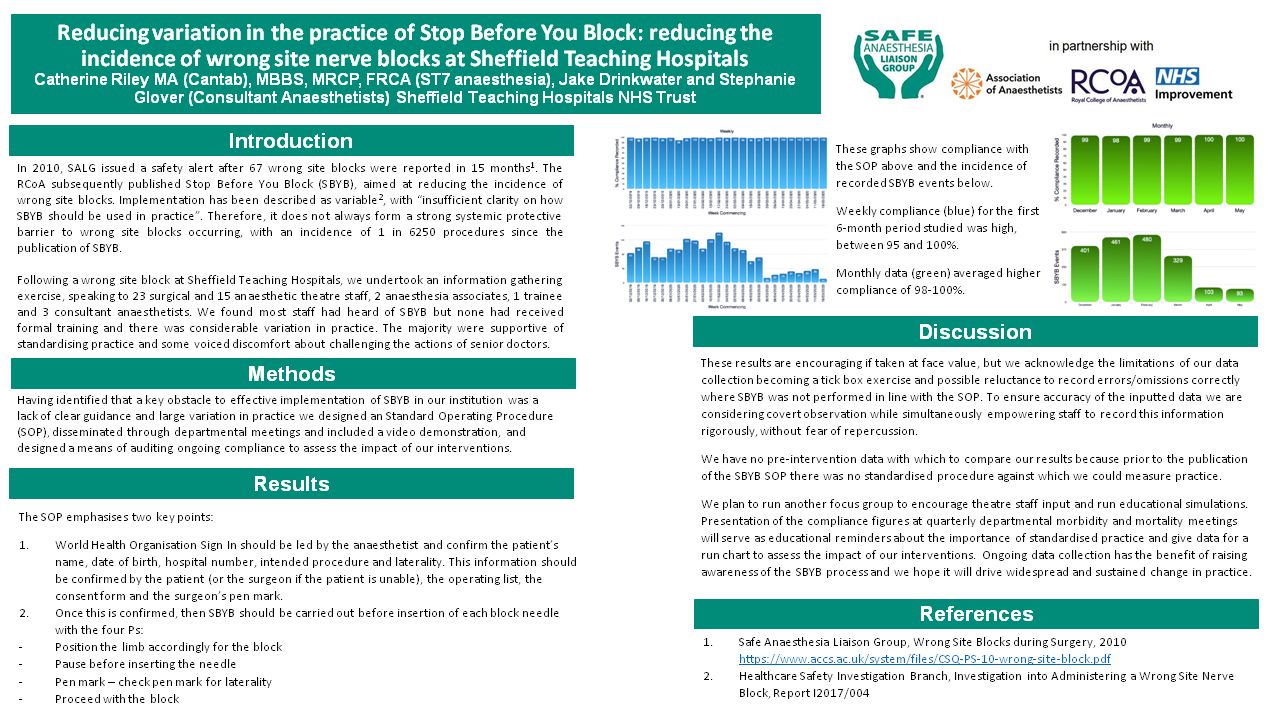
In 2010, SALG issued a safety alert after 67 wrong site blocks were reported in 15 months1. The RCoA subsequently published Stop Before You Block (SBYB), aimed at reducing the incidence of wrong site blocks. Implementation has been described as variable2, with "insufficient clarity on how SBYB should be used in practice". Therefore, it does not always form a strong systemic protective barrier to wrong site blocks occurring, with an incidence of 1 in 6250 procedures since the publication of SBYB.
Following a wrong site block at Sheffield Teaching Hospitals, we undertook an information gathering exercise, speaking to 23 surgical and 15 anaesthetic theatre staff, 2 anaesthesia associates, 1 trainee and 3 consultant anaesthetists. We found most staff had heard of SBYB but none had received formal training and there was considerable variation in practice. The majority were supportive of standardising practice and some voiced discomfort about challenging the actions of senior doctors.
With this information, we recorded a video of the model way to perform SBYB using an actor patient with real staff performing their own roles in real time. We emphasised two key points:
After launching this video and delivering training sessions, we undertook an audit asking if SBYB had been performed according to this Standard Operating Procedure. Weekly compliance for the first 6-month period studied was high, between 95 and 100%; monthly data averaged higher compliance of 98-100%.
While encouraging, to ensure accuracy of the inputted data we are considering covert observation while simultaneously empowering staff to record this information correctly, without fear of repercussion. Our aim is to change behaviour, embedding safety into routine practice. A mark of progress would be decreased variation in practice.