
002
CardMedic - Disaster Innovation: Breaking Through the PPE (Personal Protective Equipment) Barrier and Improving Communication Between Frontline Healthcare Staff and COVID-19 Patients
002
002
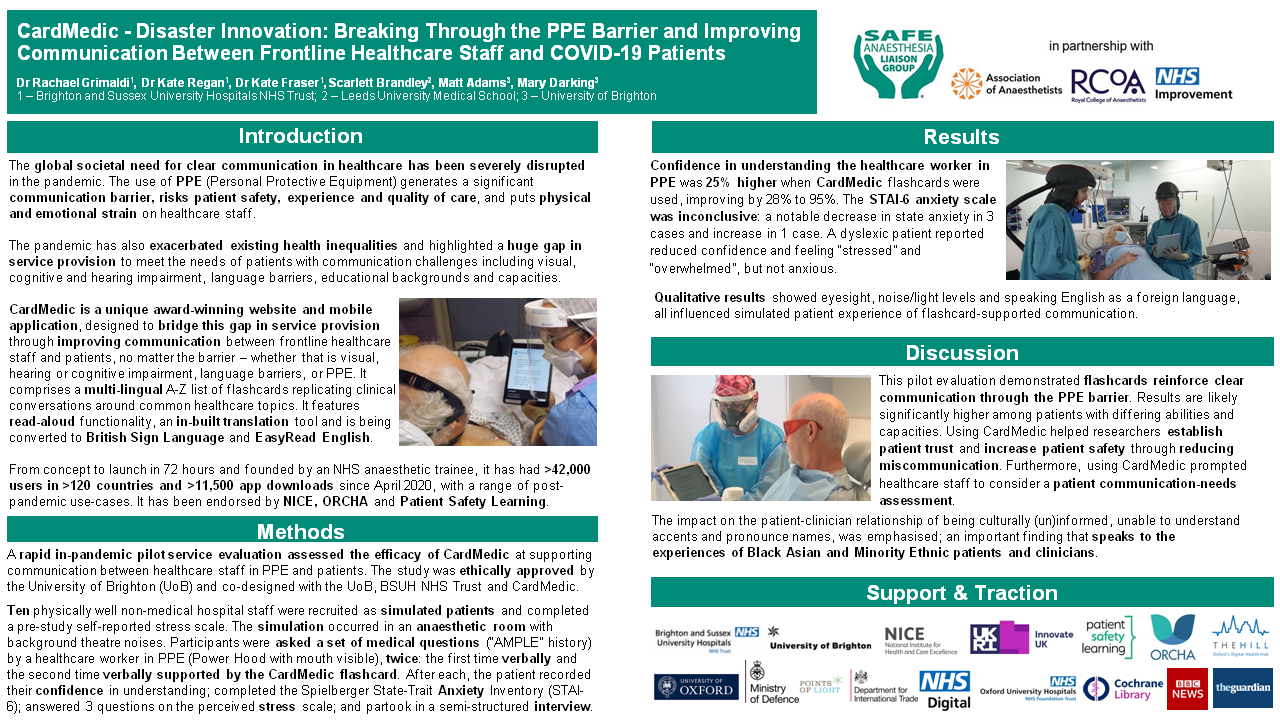
The use of PPE (Personal Protective Equipment) in the COVID-19 pandemic generates a significant communication barrier, risking patient safety, experience and quality of care. Wearing PPE is fatiguing, increasing efforts to convey information and emotional support. For patients, communicating with healthcare staff in PPE can be distressing, more so for those with existing communication needs. The PPE barrier may increase avoidable deaths from prevailing health inequalities due to miscommunication leading to misdiagnosis, mistreatment and mismanagement.
CardMedic aims to improve communication between frontline healthcare staff and patients through the PPE barrier. An innovative free website (www.cardmedic.com)/app, it comprises a multi-lingual A-Z list of flashcards replicating clinical conversations around common healthcare topics. From concept to launch in 72 hours and founded by an NHS anaesthetic trainee, it has >40,000 users in >120 countries since April 1st, with a range of post-pandemic use-cases.
A rapid in-pandemic pilot evaluation assessed CardMedic at supporting communication between healthcare staff in PPE and patients. Ten physically well non-medical hospital staff recruited as simulated patients, completed a pre-study self-reported stress scale. The simulation occurred in an anaesthetic room with background ICU noise. Participants were asked a set of medical questions by a healthcare worker in PPE (Power Hood/gown) twice:
1.Verbally
2.Verbally+flashcard
After each, the patient recorded their confidence in understanding, completed the Spielberger State-Trait Anxiety Inventory (STAI-6) and answered 3 questions.
Confidence in understanding was 25% higher when flashcards were used, improving by 28% to 95%. The STAI-6 was inconclusive: decrease in 3 cases and increase in 1 case (dyslexic). Qualitative results showed eyesight, noise/light levels and foreign language, all influenced experience. Researchers reported being enabled to establish patient trust and commitment to effective communicating despite PPE, increasing patient safety through reducing miscommunication.
This pilot evaluation shows flashcards reinforce clear communication through the PPE barrier. Results are likely significantly higher among patients with differing abilities and capacities. Evidence suggests patients may experience an increased sense of trust and safety using CardMedic.