

003
Prone position pressure ulcers: A retrospective analysis of two different prone positions used in a district general Intensive care unit during the initial Covid-19 pandemic
003
003
Pressure ulcers are a serious complication of hospital stays, associated with immobility. They can cause sepsis and overall, a poorer prognosis for patients [1]. The prevention of pressure ulcerations in Intensive Care Units (ICUs) is usually a well-managed practice with minimal ulcerations. However, patients ventilated in the prone position have been found to have nearly twice the incidence of pressure ulcers than supine patients [2].
During the Covid 19 pandemic we saw a sharp rise in the numbers of patients requiring prone ventilation and a similar rise in pressure ulcer incidence. Due to concerns that the prone face cushions were contributing to ulcer rates, in May, our proning strategy changed to the Swimmers position with regular repositioning.
We conducted a retrospective analysis of patients proned in March to June, using a face cushion (group 1) or in the swimmers position (group 2) to assess the ulcer incidence. Information on the patients and the ulcers was gathered from the ICU records and the serious incident reports. We excluded any reports of ulcers not related to proning.
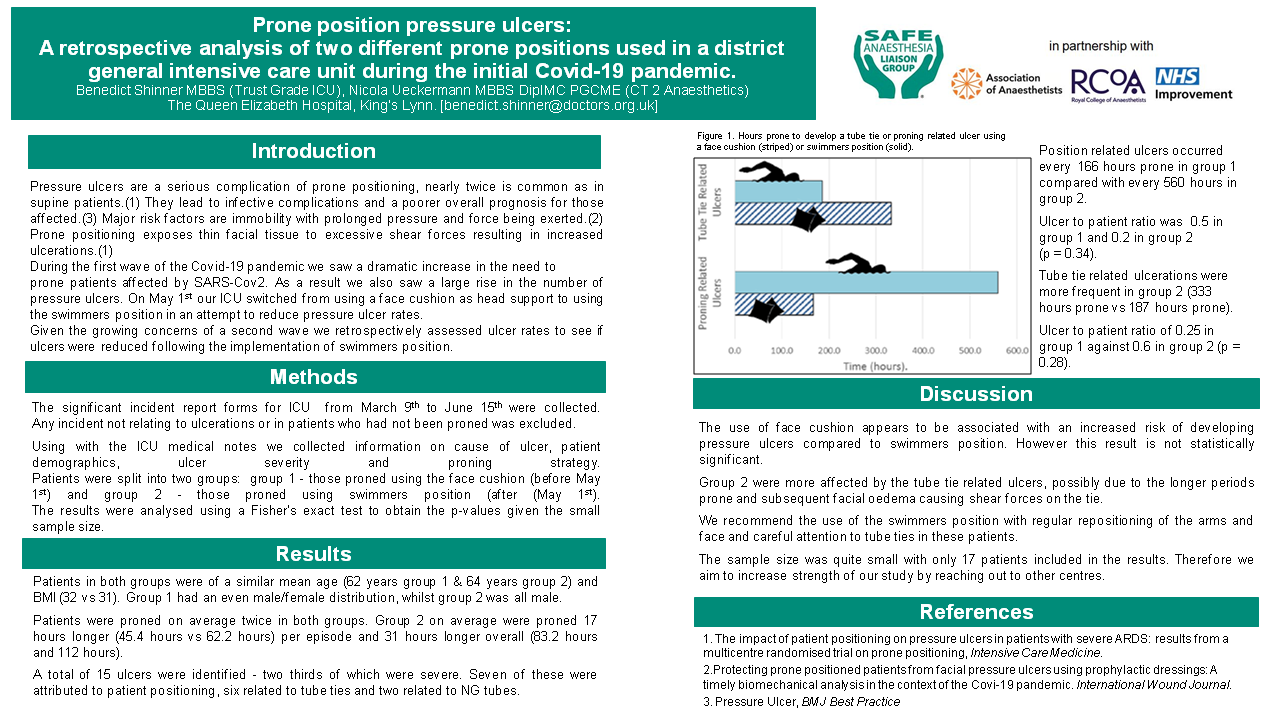
Group 1 (n=12) was larger than group 2 (n=5) but proning strategy remained the same. The only difference being that those in group 2 had longer proning episodes than group 1 (median 48 and 68 hours respectively). We identified 15 ulcers, 7 related to the prone position of which 86% occurred in group 1. Six ulcers were related to endotracheal tube ties whilst prone (50% in each group). When the ulcer numbers are compared against the total time prone we found that in group 1 it took 166 hours to develop a prone related ulcer and 333 hours to develop a tube tie related ulcer. Whereas in group 2 it took 560 hours for a prone related ulcer and 187 hours for a tube tie related ulcer (Fig 1).
Figure 1: Hours prone to develop a proning or tube tie related ulcer with patients using a face cushion (striped) or in swimmers position (solid)
In summary, we found a lower incidence of proning related ulcers in the swimmers position. This is thought to be due to regular repositioning. For tube tie related ulcers we found a higher incidence with the swimmers position group. This is thought to be secondary to the longer time prone contributing to facial oedema. We recommend the use of swimmers position whilst prone to mitigate pressure ulcer formation. No funding was required.
