015
The Royal College of Anaesthetists provides guidelines recommending the mandatory presence of decision support systems for crisis scenarios. They propose that these should be immediately and readily available at sites where anaesthesia and sedation are provided. Juniors can face challenging crises whilst working within ever changing teams. Anecdotal evidence shows that various aspects of our role, such as task allocation, adverse human factors etc. are improved by the presence of guidelines, particularly in time critical situations.
At a UK tertiary centre that provides highly specialised care over multiple sites, I visually reviewed the presence and concordance of guidelines with the most recent, peer reviewed, emergency guidelines available in areas where anaesthesia was delivered. In total, 33 sites were assessed. A site was considered to be the combination of anaesthetic room and operating theatre. The three mandatory guidelines were Advanced Life Support (ALS), Difficult Airway Management (DAS) and Major Haemorrhage. The four strongly recommended guidelines were Anaphylaxis, Malignant Hyperthermia, Peri-arrest (both tachycardia and bradycardia) and Local Anaesthetic Toxicity (LAST).
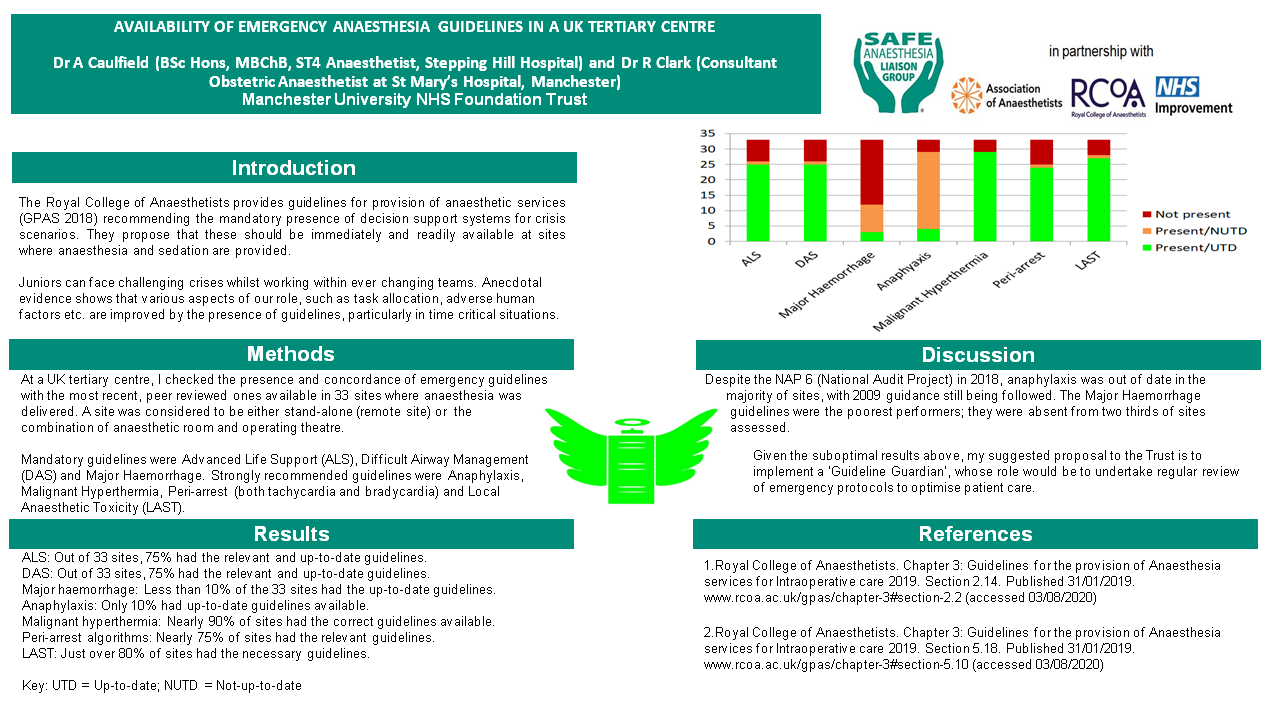
ALS: Out of 33 sites, 75% had the relevant and up-to-date guidelines. DAS: Out of 33 sites, 75% had the relevant and up-to-date guidelines. Major haemorrhage: Less than 10% of the 33 sites had the up-to-date guidelines. Anaphylaxis: Only 10% had up-to-date guidelines available. Malignant hyperthermia: Nearly 90% of sites had the correct guidelines available. Peri-arrest algorithms: Nearly 75% of sites had the relevant guidelines. LAST: Just over 80% of sites had the necessary guidelines.
From 33 sites assessed, ED (Emergency Department) resus proved to be the only area where all three mandatory guidelines were present and up-to-date. No area had all four strongly recommended emergency guidelines present and up-to-date. Despite the NAP 6 (National Audit Project) in 2018, anaphylaxis was out of date in the majority of sites, with 2009 guidance still being followed. The Major Haemorrhage guidelines were the poorest performers; they were absent from two thirds of sites assessed.
Given the suboptimal results above, my suggested proposal to the Trust is to implement a ‘Guideline Guardian’, whose role would be to undertake regular review of emergency protocols to optimise patient care.