041
Do you know the names of your colleagues? That was the question posed when the arrival of COVID-19 resulted in the creation of a new satellite ‘Green’ ICU in Edinburgh Western General Hospital. The unit was staffed by team members redeployed from multiple areas with varying degrees of critical care experience. Compulsory personal protective equipment (PPE) further exacerbated communication issues, and with unfamiliar team members, unfamiliar skill sets in an unfamiliar environment, had the potential to create a scenario for critical incidents or adverse events to occur. Better identification of team members and their skill set enables more effective communication and teamwork, which is well recognised in the provision of good patient care [1].
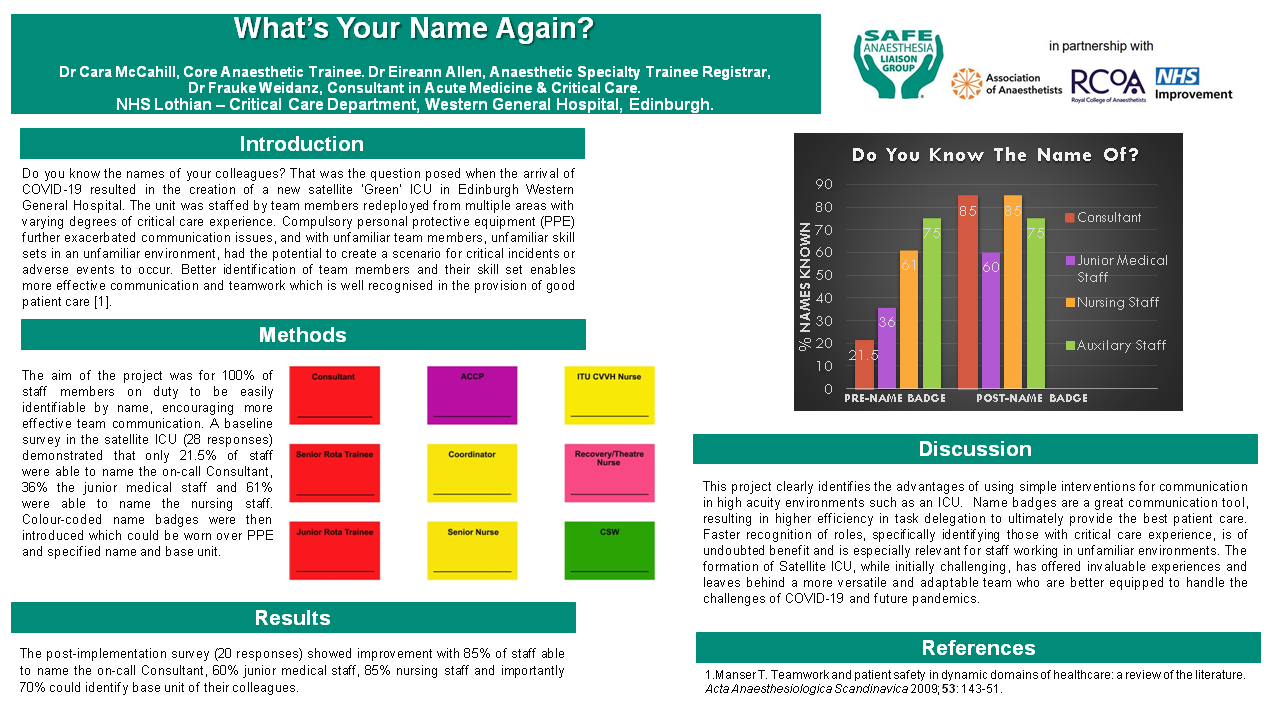
The aim of the project was for 100% of staff members on duty to be easily identifiable by name, encouraging more effective team communication. A baseline survey in the satellite ICU (28 responses) demonstrated that only 21.5% of staff were able to name the on-call Consultant, 36% the junior medical staff and 61% were able to name all nursing staff on shift. Colour-coded name badges were then introduced which could be worn over PPE and specified name and base unit. The post-implementation survey (20 responses) showed improvement with 85% of staff able to name the on-call Consultant, 60% junior medical staff, 85% nursing staff and importantly 70% could identify base unit of their colleagues.
This project clearly identifies the advantages of using simple interventions for communication in high acuity environments such as an ICU. Name badges are a great communication tool, resulting in higher efficiency in task delegation to ultimately provide the best patient care. Faster recognition of roles, specifically identifying those with critical care experience, is of undoubted benefit and is especially relevant for staff working in unfamiliar environments. The formation of Satellite ICU, while initially challenging, has offered invaluable experiences and leaves behind a more versatile and adaptable team who are better equipped to handle the challenges of COVID-19 and future pandemics.