

053
Audit of anaesthetic practice for incision and drainage of lower body abscesses before and after COVID-19
053
053
Incision and drainage (i&d) of abscesses make up a large proportion of cases on the emergency list. The COVID-19 pandemic has highlighted the need for consideration of alternative anaesthetic techniques to a general anaesthetic (GA). A literature review conducted by Uppal V et al recommends the use of neuroaxial anaesthesia and peripheral nerve blocks whenever possible in those with suspected COVID-19 infections [1]. This audit looks at the anaesthetic practice for i&d of abscess on the emergency list pre and post COVID-19, to help determine if there is an impact on post operative nausea and vomiting (PONV), pain, and duration of hospital stay.
Patients undergoing an i&d of lower body abscess were identified between 1/1/20 – 29/2/20 (pre COVID-19) and 1/3/20 – 9/5/20 (post COVID-19). The patients’ electronic records were reviewed and the following data collected: age, ASA, gender, weight, BMI, co-morbidities, inflammatory markers, NEWS score, anaesthetic administered, post op anti-emetics and analgesics, problems encountered and duration of stay.
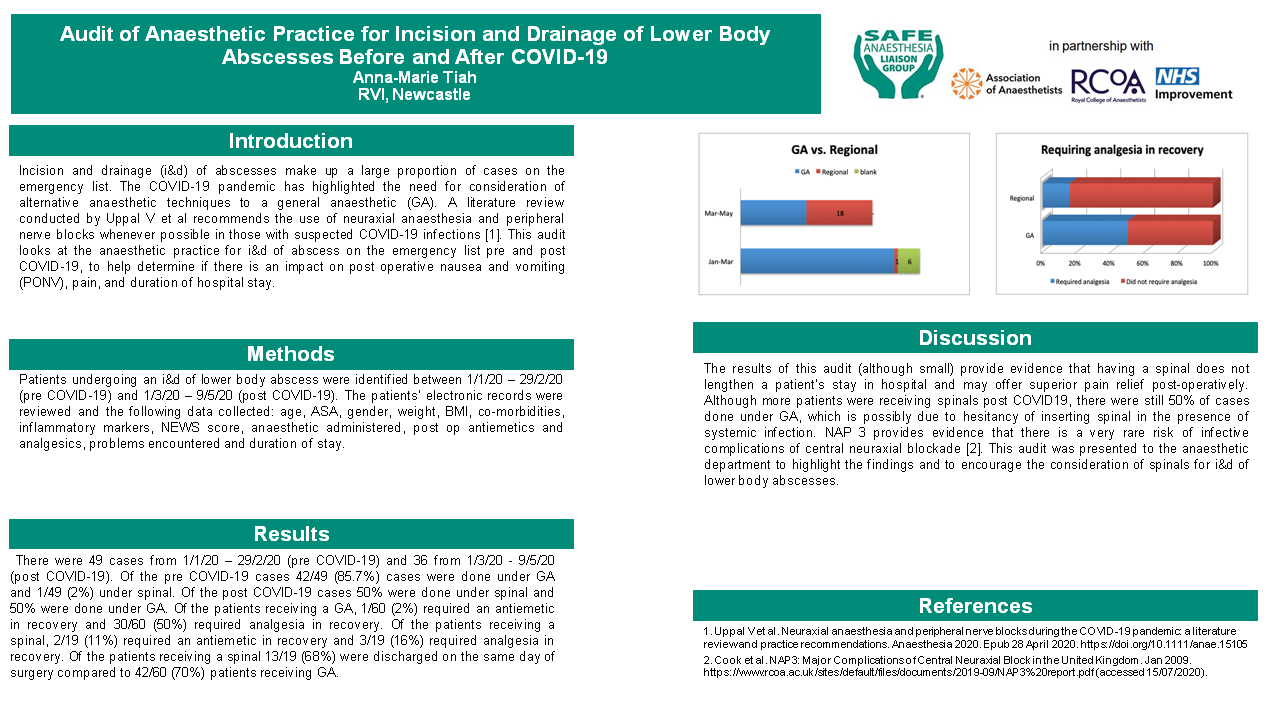
There were 49 cases from 1/1/20 – 29/2/20 (pre COVID-19) and 36 from 1/3/20 - 9/5/20 (post COVID-19). Of the pre COVID-19 cases 42/49 (85.7%) cases were done under GA and 1/49 (2%) under spinal. Of the post COVID-19 cases 50% were done under spinal and 50% were done under GA. Of the patients receiving a GA, 1/60 (2%) required an antiemetic in recovery and 30/60 (50%) required analgesia in recovery. Of the patients receiving a spinal, 2/19 (11%) required an antiemetic in recovery and 3/19 (16%) required analgesia in recovery. Of the patients receiving a spinal 13/19 (68%) were discharged on the same day of surgery compared to 42/60 (70%) patients receiving GA.
The results of this audit (although small) provide evidence that having a spinal does not lengthen a patient’s stay in hospital and may offer superior pain relief post-operatively. Although more patients were receiving spinals post COVID-19, there were still 50% of cases done under GA, which is possibly due to hesitancy of inserting spinal in the presence of systemic infection. NAP 3 provides evidence that there is a very rare risk of infective complications of central neuraxial blockade [2]. This audit was presented to the anaesthetic department to highlight the findings and to encourage the consideration of spinals for i&d of lower body abscesses.