

004
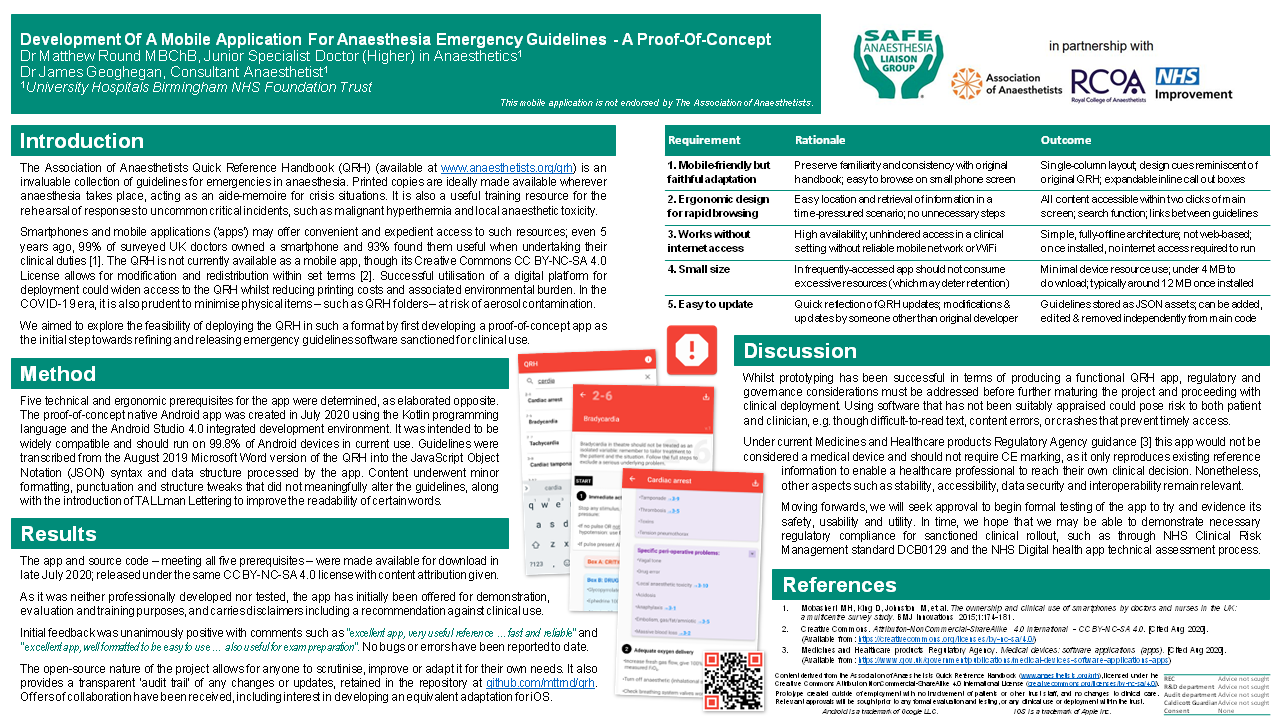
Development of a mobile application for anaesthesia emergency guidelines - a proof-of-concept
004
004
The Association of Anaesthetists Quick Reference Handbook (QRH) (available at www.anaesthetists.org/qrh) is an invaluable collection of guidelines for emergencies in anaesthesia. Printed copies are ideally made available wherever anaesthesia takes place, acting as an aide-memoire for crisis situations.
Smartphones and mobile applications ('apps') may offer convenient and expedient access to such resources; even 5 years ago, 99% of surveyed UK doctors owned a smartphone and 93% found them useful when performing clinical duties [1]. The QRH is not officially available as a mobile app, though its Creative Commons (CC) BY-NC-SA 4.0 License allows for modification and redistribution within set terms [2].
There are many challenges to developing an effective mobile app. A proof-of-concept was created for the Android platform to demonstrate that the QRH could plausibly be translated to a mobile format. Five prerequisites were determined:
1. Faithful but mobile-friendly replication
2. Ergonomic design for rapid browsing
3. Works without internet access
4. Small size
5. Easy to update
The rationale, challenges and outcome for each of these are addressed in this poster. Attribution is given for the source material, whilst ensuring the app’s unofficial nature is clear. Under current MHRA guidance "Medical devices: software applications (apps)" (June 2020) the app would not be a medical device and should not require CE marking. However, given that it has been neither professionally developed nor tested, the app is presently offered for evaluation, training and simulation purposes, and carries a recommendation against clinical use.
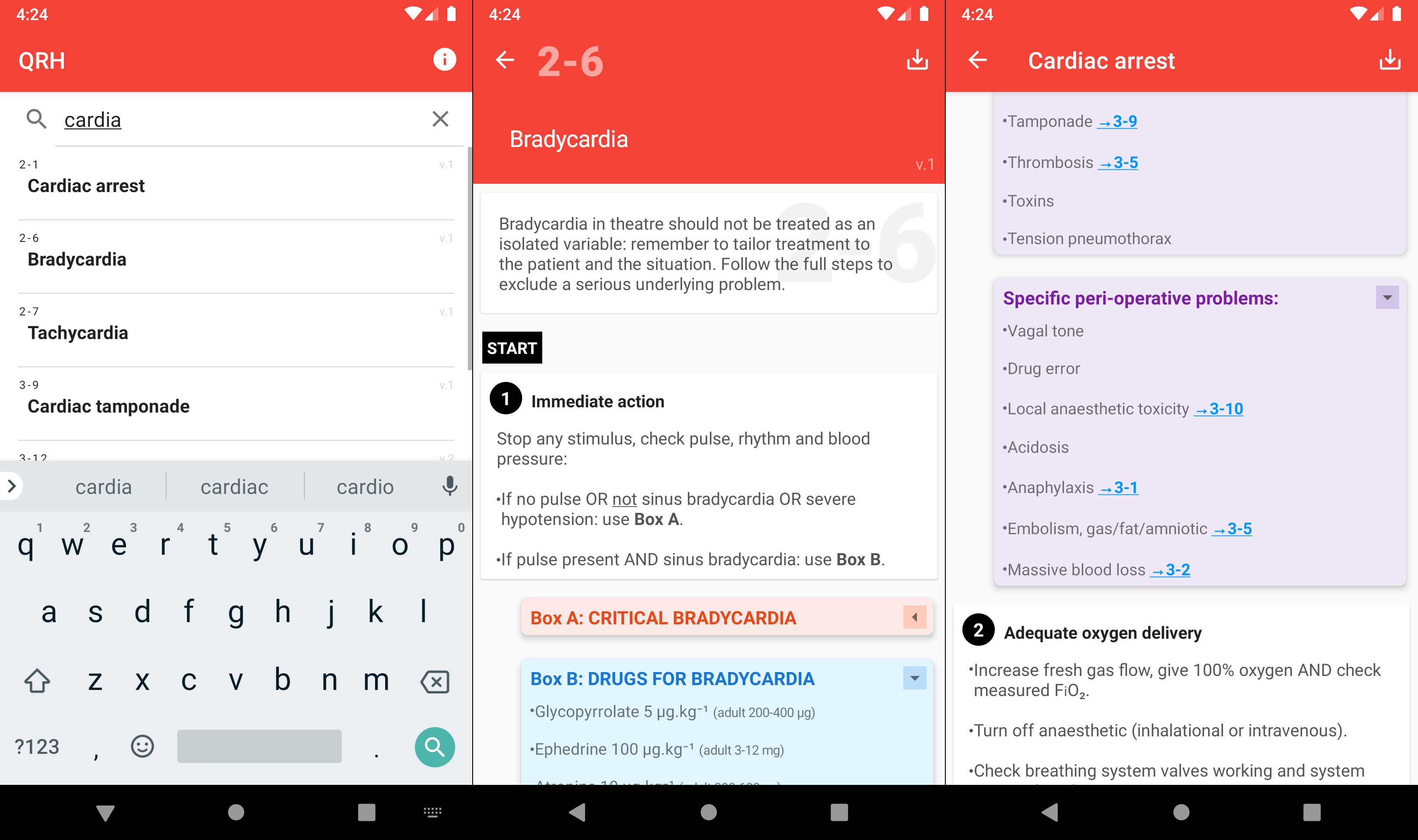
Figure 1. App screenshots
The app was made available for download on 20th July 2020 and has since been installed over 60 times. Initial feedback has been unanimously positive with comments such as "excellent app, very useful reference … fast and reliable" and "excellent app, well formatted to be easy to use … also useful for exam preparation". No bugs or errors have been reported to date. Some clinicians have expressed interest in developing prototypes for other platforms. Future efforts may include usability testing and technical assessments working towards sanctioned clinical use.
The app and source-code are available via anaes.dev/qrh (CC BY-NC-SA 4.0 [2]). It is not endorsed by The Association of Anaesthetists.
No funding sources.