

Poster no: 060
Post intubation checklist - routine evaluation prevents oesophageal intubation
Poster no: 060
060
In the UK, 2.9 million general anaesthetics are given each year, of which 38% are managed with an endotracheal tube [1]. This is a task frequently performed by anaesthetists and not recognising oesophageal intubation is catastrophic for patients, with high morbidity and mortality rates. There has been one episode of unrecognised oesophageal intubation locally which resulted in mortality. A two person checklist performed together by the anaesthetist and anaesthetic assistant will promote safety and prevent oesophageal intubation from occurring.
Methods
The post-intubation checklist was derived from a review of the fourth National Audit Project, current literature and local feedback from trainees, staff grades, consultant anaesthetists and current anaesthetic assistants. This checklist includes a series of steps to be taken immediately following intubation in the Anaesthetic room, prior to moving the patient into the theatre.
Results
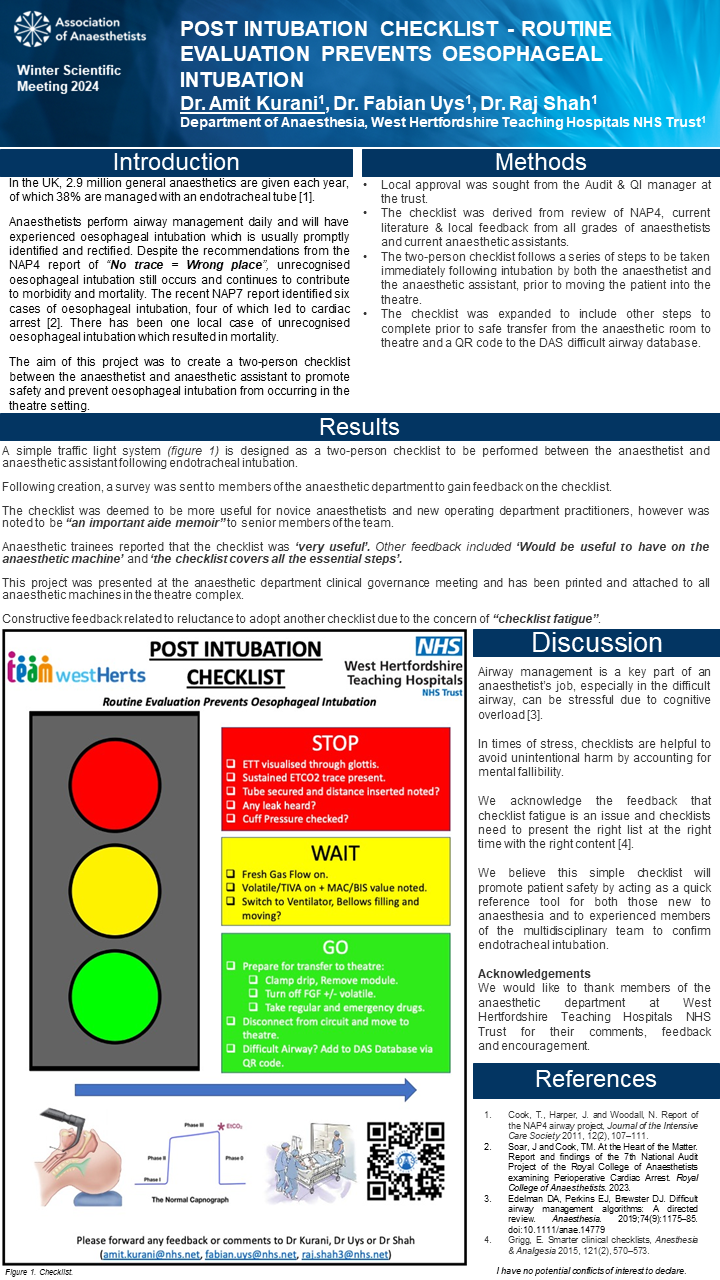
A survey was sent to members of the theatre MDT to gain feedback on the checklist. Anaesthetic trainees reported that the checklist was ‘very useful’. Specific feedback included: ‘Would be useful to have on the anaesthetic machine’ and ‘the checklist covers all the essential steps’. Constructive feedback related to reluctance to adopt a further checklist. This project was presented at the anaesthetic department clinical governance meeting and has been printed and attached to all anaesthetic machines in the theatre complex. As can be seen in image one, a simple traffic light system has been designed to aid with a rapid sequence of checks to be performed between the anaesthetist and anaesthetic assistant following endotracheal intubation.
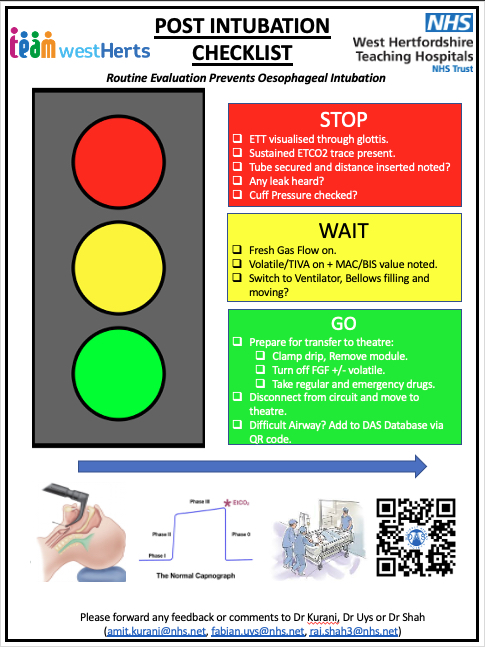
Figure 1. Post intubation checklist.
Discussion
Anaesthetists perform airway management daily and have all at some point intubated the oesophagus. This is usually promptly identified and rectified. In times of stress, checklists are helpful to avoid unintentional harm by accounting for mental fallibility. We acknowledge the feedback that checklist fatigue is an issue and checklists need to present the right list at the right time with the right content [2]. We believe this checklist to be invaluable to members of the multidisciplinary team as a two person check that endotracheal intubation has occurred successfully.
Acknowledgements
We would like to thank all members of the anaesthetic department at West Hertfordshire Teaching Hospitals NHS Trust for their comments, feedback and encouragement.