

Poster no: 119
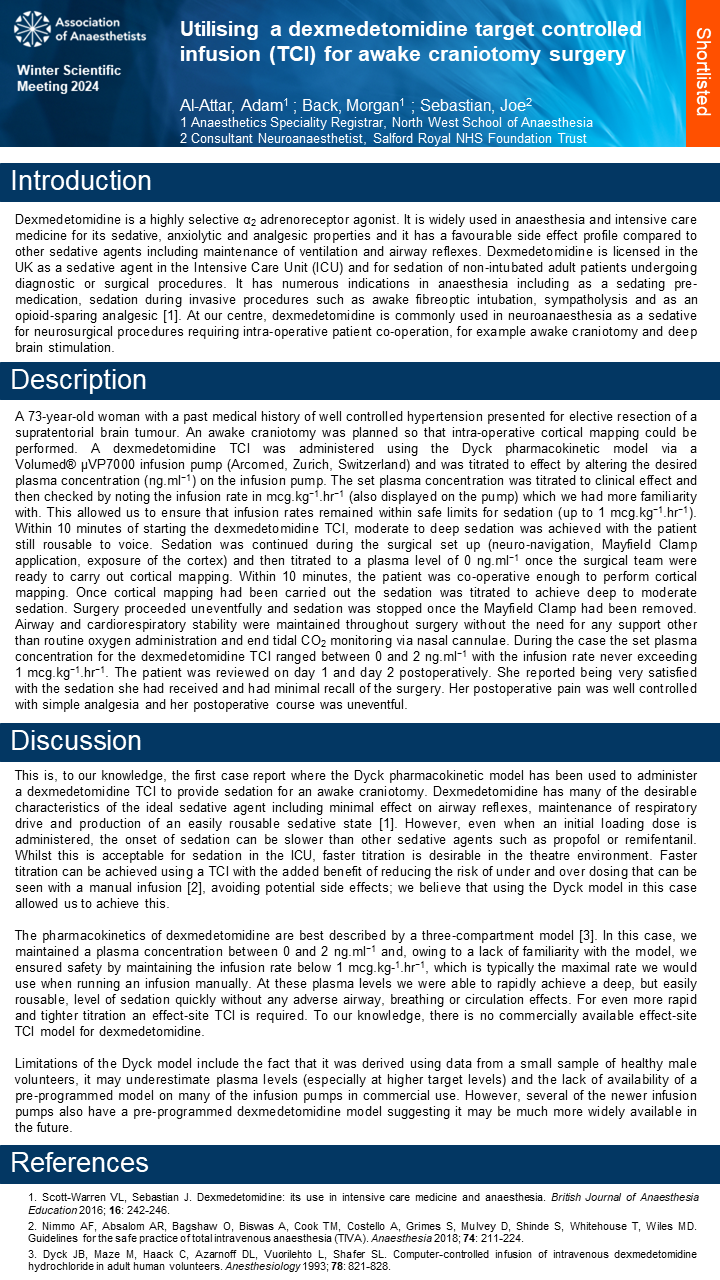
Utilising a dexmedetomidine target controlled infusion (TCI) for awake craniotomy surgery
Poster no: 119
119
Dexmedetomidine is a highly selective α2 adrenoreceptor agonist. It is widely used in anaesthesia and intensive care medicine for its sedative, anxiolytic and analgesic properties and has a favourable side effect profile compared with other sedative agents[1]. In this case report we describe providing sedation for awake craniotomy surgery using a dexmedetomidine target controlled infusion (TCI).
Description
A 73 year old woman with a past medical history of hypertension presented for elective resection of a supratentorial brain tumour. An awake craniotomy was planned so that intra-operative cortical mapping could be performed. A dexmedetomidine TCI was administered using the Dyck pharmacokinetic model via an Arcomed Volumed µVP7000 infusion pump (Arcomed) and was titrated to effect by altering the desired plasma concentration (ng/ml) on the infusion pump. Within 10 minutes of starting the dexmedetomidine TCI, moderate to deep sedation was achieved with the patient still rousable to voice. Sedation was continued during the surgical set up (neuro-navigation, Mayfield Clamp application, exposure of the cortex) and then titrated to a plasma level of 0 ng/ml once the team were ready to perform cortical mapping. Within 10 minutes the patient was co-operative enough to perform cortical mapping. Once cortical mapping had been carried out sedation was titrated to achieve deep to moderate sedation. Surgery proceeded uneventfully and sedation was stopped once the Mayfield Clamp had been removed. Airway and cardiorespiratory stability were maintained throughout surgery without the need for any organ support. Patient satisfaction was high post-operatively.
Discussion
This is, to our knowledge, the first report of the Dyck pharmacokinetic model being used to administer a dexmedetomidine TCI for this purpose. Whilst the use of manual dexmedetomidine infusions for awake craniotomy is well established, the onset time for sedation using this method is slower than other sedative agents such as propofol. Using the Dyck model resulted in rapid titration of sedation, allowing for deeper sedation during stimulating parts followed by lighter/no sedation during cortical mapping whilst maintaining dexmedetomidine's favourable side effect profile. Additionally utilising a TCI avoids the need to manually perform a loading dose followed by having to calculate infusion rates.
Acknowledgements
The authors extend their thanks to the patient for consenting to share this case report.