

Poster no: 003
Patients with class III obesity (Body Mass Index 40kg/m2) undergoing robotic hysterectomy in a UK tertiary cancer centre: a service evaluation
Poster no: 003
003
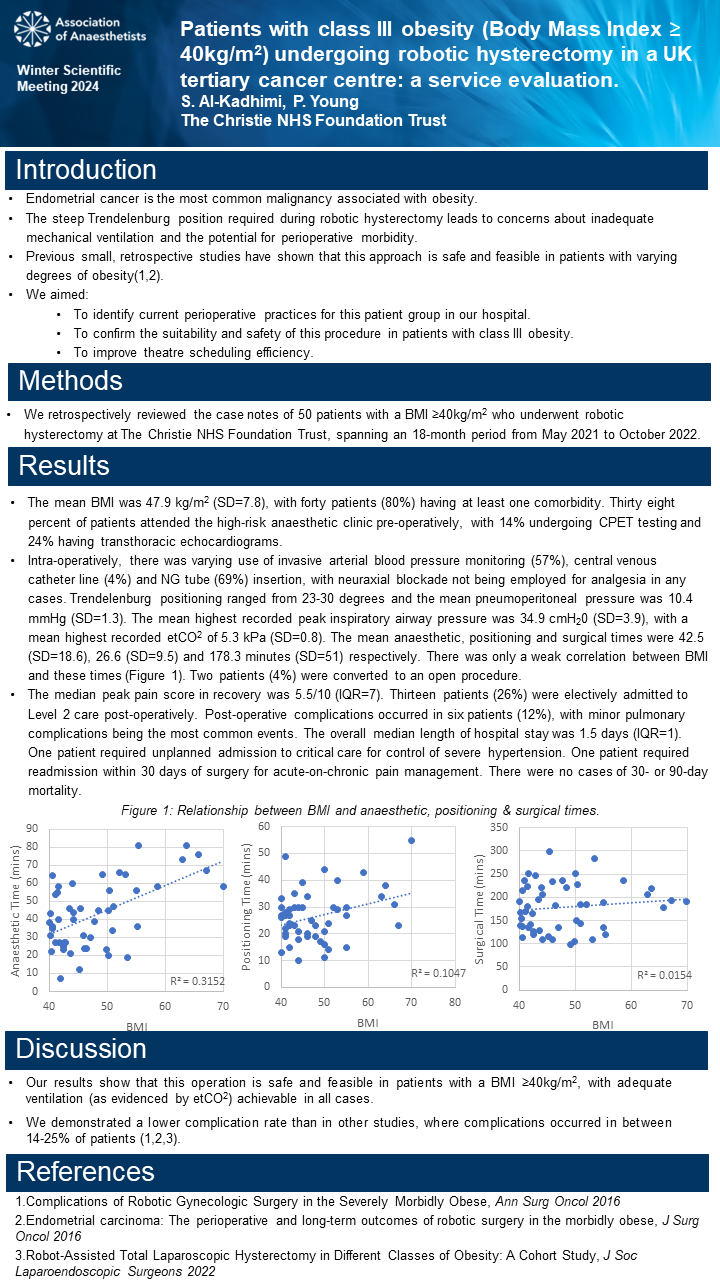
Robotic hysterectomy for the treatment of endometrial cancer offers significant advantages when compared to an open procedure, including reduced length of hospital stay and fewer postoperative complications [1]. However, the steep Trendelenburg postioning required during surgery raises concerns about inadequate mechanical ventilation in patients with obesity. This service evaluation examines the peri-operative management of patients with a BMI ≥40kg/m2 undergoing this procedure, assessing the suitability of this approach and aiming to improve theatre scheduling efficiency by identifying typical anaesthetic and surgical time requirements.
Methods
Data were collected retrospectively for patients with a BMI ≥40kg/m2 who underwent robotic hysterectomy for the period May 2021 - October 2022.
Results
Fifty cases were identified, with a mean BMI of 47.9 kg/m2 (SD=7.8). Forty patients (80%) had at least one comorbidity. Intra-operatively, there was varying use of invasive arterial blood pressure monitoring (57%), central venous catheter line (4%) and NG tube (69%) insertion, with neuraxial blockade not being employed for analgesia in any cases. Trendelenburg postioning ranged from 23-30 degrees and the mean pneumoperitoneal pressure was 10.4 mmHg (SD=1.3). The mean highest recorded peak inspiratory airway pressure was 34.9 cmH2O (SD=3.9), with a mean highest recorded end-tidal carbon dioxide (etCO2) of 5.3 kPa (SD=0.8). The mean anaesthetic and surgical times were 42.5 minutes (SD=18.6) and 178.3 minutes (SD=51) respectively. Two patients (4%) were converted to an open procedure. The median peak pain score in recovery was 5.5/10 (IQR=7). Thirteen patients (26%) were electively admitted to Level 2 care post-operatively. Post-operative complications occurred in six patients (12%), with minor pulmonary complications being the most common events. The overall median length of hospital stay of 1.5 days (IQR=1). One patient required an unplanned admission to crticial care for control of severe hypertension. One patient required readmission within 30 days of surgery for acute-on-chronic pain management. There were no cases of 30- or 90-day mortality. The median 'days alive and at home within 30 days' after surgery (DAH-30) score was 28.5 days (IQR=1).
Discussion
Our results show that this operation is safe and feasible in patients with a BMI ≥40, with a low rate of significant complications. Adequate ventilation (as evidenced by etCO2) was achievable in all cases.