

Poster no: 054
Impact of pre-operative pain medications on postoperative health-related quality of life after emergency laparotomy
Poster no: 054
054
The National Emergency Laparotomy Audit (NELA) was instituted to enhance the understanding of inpatient care and outcomes for emergency bowel surgery patients in England and Wales. Commissioned by the Healthcare Quality Improvement Partnership (HQIP) and funded by NHS England and the Welsh government, NELA seeks to drive quality improvements. Our work investigated the repercussions of preoperative pain medications on postoperative health-related quality of life (HRQoL), adding to the understanding of patient outcomes.
Methods
One hundred and nine complete datasets that included EQ5D outcomes and preoperative pain medication use in emergency laparotomy patients were identified for analysis within the 1052 NELA entries at University Hospital Wales. Regression models examined associations between EQ5D dimensions (e.g., mobility) and preoperative pain medications (opioids, neuropathic agents, antidepressants).
Results
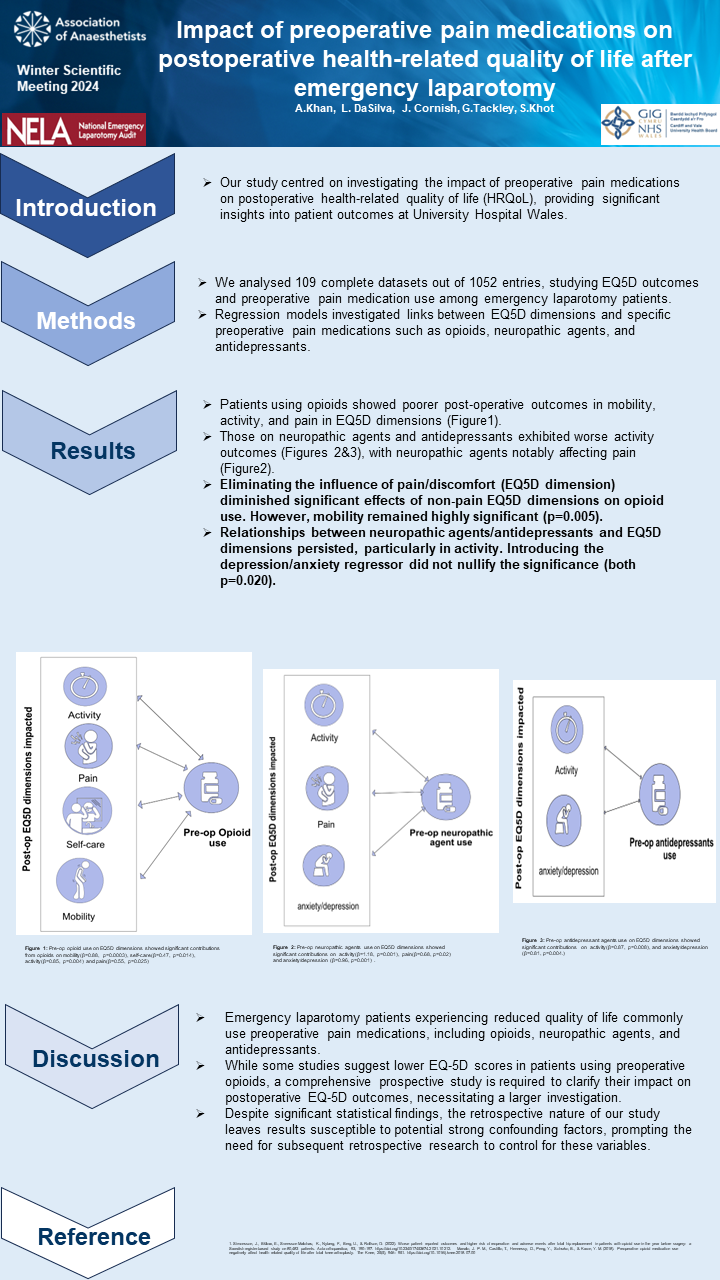
Regression models exploring the contribution of pre-operative pain medication on post-operative EQ5D dimensions showed significant contributions from opioids on mobility(p=0.0003), self-care(p=0.014), activity(p=0.004) and pain(p=0.025); from neuropathic agents and antidepressants on activity(p=0.001/p=0.008), on anxiety/depression(p=0.001/p=0.004); and from neuropathic agents on pain(p=0.02). Regressing-out the influence of pain/discomfort (EQ5D dimension) obviated the effect of opioids on all non-pain dimensions except mobility which remained highly significant (p=0.005) whilst with neuropathic agents & antidepressants the relationships with EQ5D dimensions remained intact, notably for activity where the addition of a depression/anxiety regressor did not abolish significance (both p=0.020).
Discussion
Our work reveals that HRQoL among emergency laparotomy patients is diminished in those receiving preoperative pain medications—namely opioids, neuropathic agents, and antidepressants. While certain studies have reported lower EQ-5D scores among patients with preoperative opioid use1,2, there exists a need for comprehensive prospective data to elucidate the influence of preoperative opioids on postoperative EQ-5D outcomes for emergency laparotomy patients, warranting a larger investigation.Despite the statistical significance observed the retrospective nature of our study leaves the results subject to potentially strong confounding factors that can only be controlled for by a follow-on retrospective study.
Acknowledgements
Ms J Cornish, Ms L Silva