

Poster no: 004
Liposomal bupivacaine for parasternal blocks in cardiac surgery: a promising addition to the peri-operative toolbox?
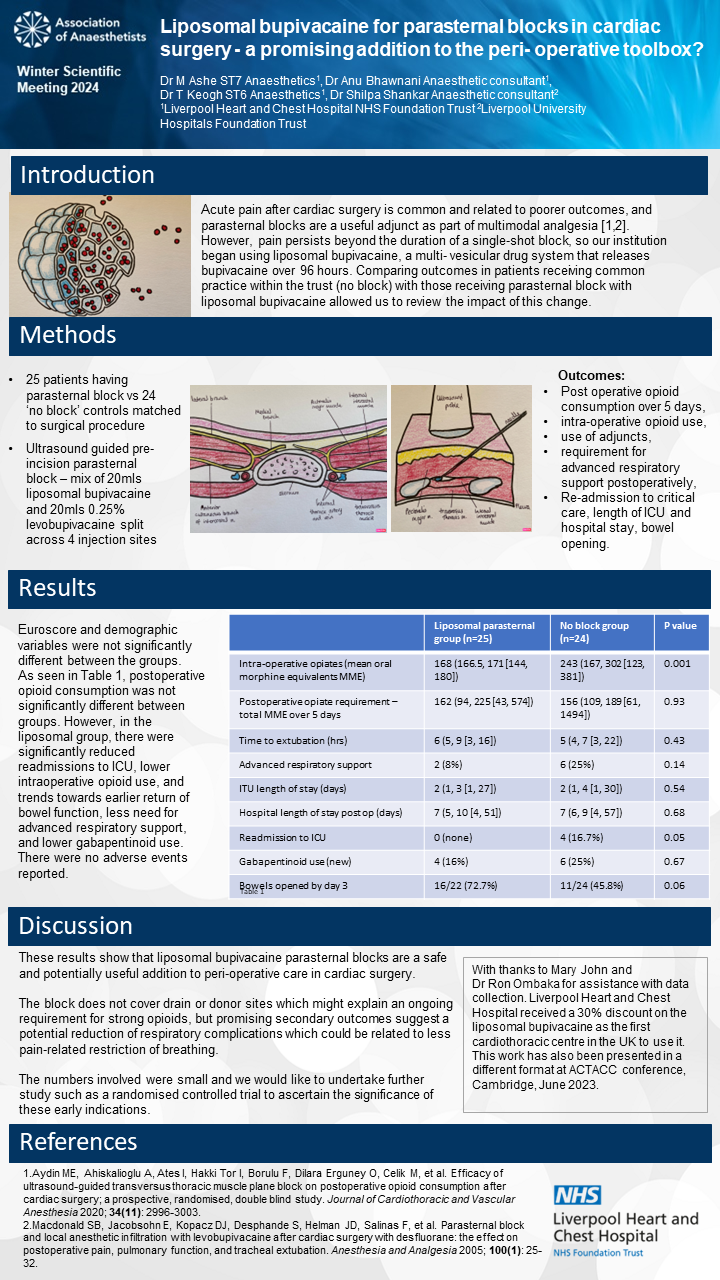
Poster no: 004
004
Acute pain after cardiac surgery is common and related to poorer outcomes, and parasternal blocks are a useful adjunct as part of multimodal analgesia [1, 2]. However, pain persists beyond the duration of a single-shot block, so our institution began using liposomal bupivacaine, a multi-vesicular drug system that releases bupivacaine over 96 hours. Comparing outcomes in patients receiving common practice within the trust (no block) with those receiving parasternal block with liposomal bupivacaine allowed us to review the impact of this change.
Methods
Postoperative opioid consumption over five days was compared in 25 patients having cardiac surgery with an ultrasound guided pre-incision parasternal block (mix of 20mls liposomal bupivacaine and 20mls 0.25% levobupivacaine across four injection sites), with 24 patients having no block (matched to surgical procedure). Secondary outcomes included intra-operative opioid use, use of adjuncts, requirement for advanced respiratory support postoperatively, readmission to critical care, length of ICU and hospital stay, and bowel opening.
Results
Euroscore and demographic variables were not significantly different between the groups. As seen in Table 1, postoperative opioid consumption was not significantly different between groups. However, in the liposomal group, there were significantly reduced readmissions to ICU, lower intraoperative opioid use, and trends towards earlier return of bowel function, less need for advanced respiratory support, and lower gabapentinoid use. There were no adverse events reported.
Table 1. Results
| Liposomal parasternal group (n=25) | No block group (n=24) | p-value | |
| Intra-operative opiates (mean oral morphine equivalents - MME) | 168 (166.5, 171 [144, 180]) | 243 (167, 302 [123, 381]) | 0.001 |
| Postoperative opiates - total MME over 5 days | 162 (94, 225 [43, 574]) | 156 (109, 189 [61, 1494]) | 0.93 |
| Time to extubation (hrs) | 6 (5, 9 [3, 16]) | 5 (4, 7 [3, 22]) | 0.43 |
| Advanced respiratory support | 2 (8.0%) | 6 (25.0%) | 0.14 |
| ICU length of stay (days) | 2 (1, 3 [1, 27]) | 2 (1, 4 [1, 30]) | 0.54 |
| Hospital length of stay post-op (days) | 7 (5, 10 [4, 51]) | 7 (6, 9 [4, 57]) | 0.68 |
| Readmission to ICU | 0 (0.0%) | 4 (16.7%) | 0.05 |
| Gabapentinoid use (new) | 4 (16.0%) | 6 (25.0%) | 0.67 |
| Bowels opened by day 3 | 16/22 (72.7%) | 11/24 (45.8%) | 0.06 |
Discussion
These results show that liposomal bupivacaine parasternal blocks are a safe and potentially useful addition to peri-operative care in cardiac surgery. The block does not cover drain or donor sites which might explain an ongoing requirement for strong opioids, but promising secondary outcomes suggest a potential reduction of respiratory complications which could be related to less pain-related restriction of breathing. The numbers involved were small and we would like to undertake further study such as a randomised controlled trial to ascertain the significance of these early indications.
Acknowledgements
With thanks to Mary John and Dr Ron Ombaka for assistance with data collection. Liverpool Heart and Chest Hospital received a 30% discount on the liposomal bupivacaine as the first cardiothoracic centre in the UK to use it.