

Poster no: 155
SITE STORE (Site Survey of Training Opportunities in Research in East of England) - Does the region support training in research?
Poster no: 155
155
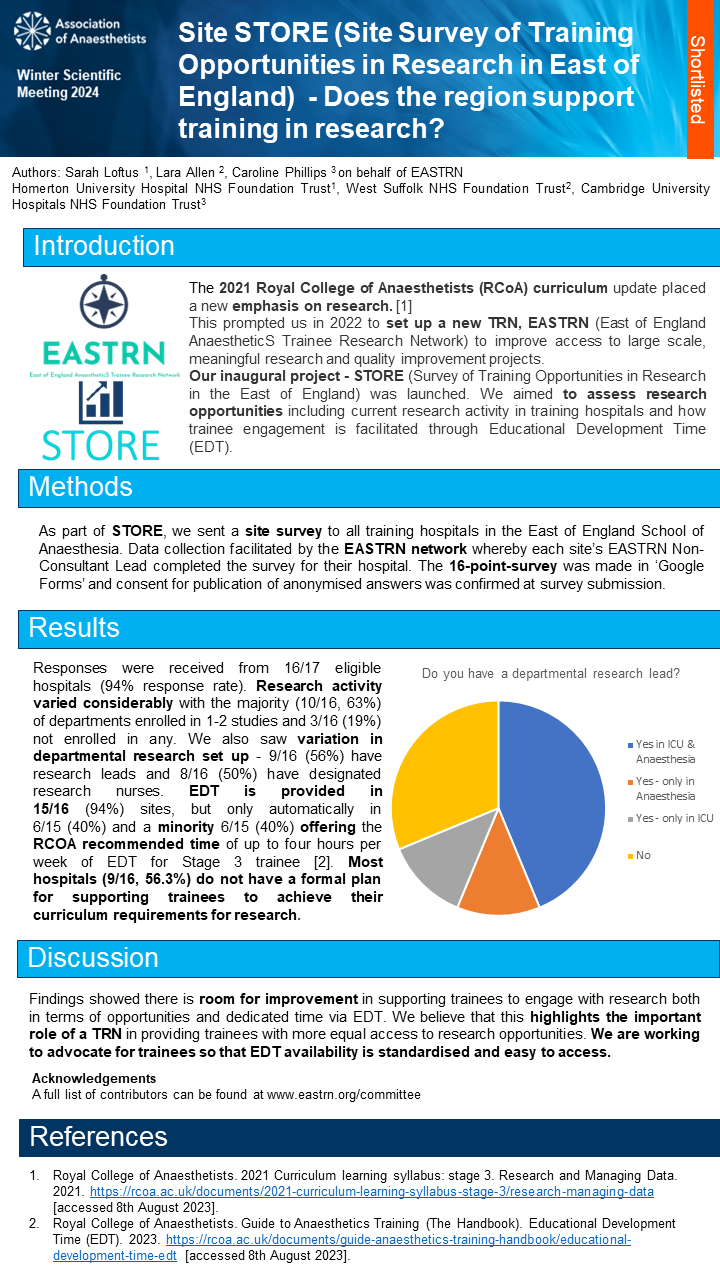
The 2021 Royal College of Anaesthetists (RCoA) curriculum dedicates a generic professional domain to ‘Research and Managing Data’. Suggested evidence for this includes involvement in a research project or local Trainee Research Networks (TRNs) [1]. In 2022 we set up a new TRN, EASTRN (East of England AnaestheticS Trainee Research Network) to improve access to large scale, meaningful research and quality improvement projects. As an inaugural project, STORE (Survey of Training Opportunities in Research in the East of England) was launched. We aimed to assess research opportunities including current research activity in training hospitals and how trainee engagement is facilitated through Educational Development Time (EDT).
Methods
As part of STORE, we sent a site survey to all training hospitals in the East of England School of Anaesthesia. Data collection was facilitated by the EASTRN network whereby each site’s EASTRN Non-Consultant Lead completed the survey for their hospital. The 16-point-survey was made in ‘Google Forms’ and consent for publication of anonymised answers was confirmed at survey submission.
Results
We received responses from 16 of 17 eligible hospitals (94% response rate). Research activity varied considerably across the region with the majority (10/16, 63%) of centres enrolled in 1-2 studies; 3/16 (19%) centres were not enrolled in any. We also saw variation in departmental research set up - 9/16 (56%) have research leads and 8/16 (50%) have designated research nurses. EDT is provided in 15/16 (94%) sites, but automatically in only 6/15 (40%) and a minority 6/15 (40%) offer up to four hours per week of EDT for Stage 3 trainees, as recommended by the RCOA [2]. Most hospitals (9/16, 56.3%) do not have a formal plan for supporting trainees to achieve their curriculum requirements for research.
Discussion
Research opportunities differ significantly across the region with enrolment in active studies varying considerably. Additionally, a large proportion of departments do not have a research lead or a plan to support trainees in research involvement. We believe that this highlights the important role of a TRN in providing trainees with more equal access to research opportunities. Additionally, although EDT is provided by most trusts, the time allowed is inconsistent. We hope to advocate for trainees so that time available is standardised and easy to access.
Acknowledgements
A full list of contributors can be found at www.eastrn.org/committee.