
Poster no: 157
Tea-trolley simulation of 'prep, stop, block' and the empowerment to speak-up
Poster no: 157
157
Wrong-side blocks (WSB) were designated as "never events" by NHS England. Despite the implementation of the Stop Before You Block (SBYB) initiative, their incidence did not decrease raising doubts about the effectiveness of SBYB [1]. a new national Standard Operating Procedure (SOP) was introduced by the Safe Anaesthesia Liaison Group (SALG) and the Regional Anaesthesia UK (RA-UK). This SOP retained the SBYB concept but divided the process into three steps: Prep, Stop, and Block (PSB). Notably, the procedure emphasizes drug and equipment handover between the blocker and assistant during Prep, confirmation of the correct side during stop immediately before needle insertion. Delays require a restart from Prep [2].
Methods
The teaching involved a tea-trolley session with an added simulation. The new protocol was introduced through a 5-minute video demonstration, followed by a simulation scenario with two facilitators. One facilitator portrayed a patient receiving an awake interscalene block. While the other played the role of a blocker or assistant based on the candidate's typical responsibilities. An intentional interruption was included after the "Stop" moment before the block was performed. Debriefing sessions after the simulation emphasized the key points of the PSB protocol. Pre teaching survey asked the candidates about the correct timing of SBYB, their confidence in both understanding the protocol and to speak up if it wasn't followed correctly. Identical survey was done after to assess efficacy. Teaching was delivered in the anaesthetic room environment as the daily practice.
Results
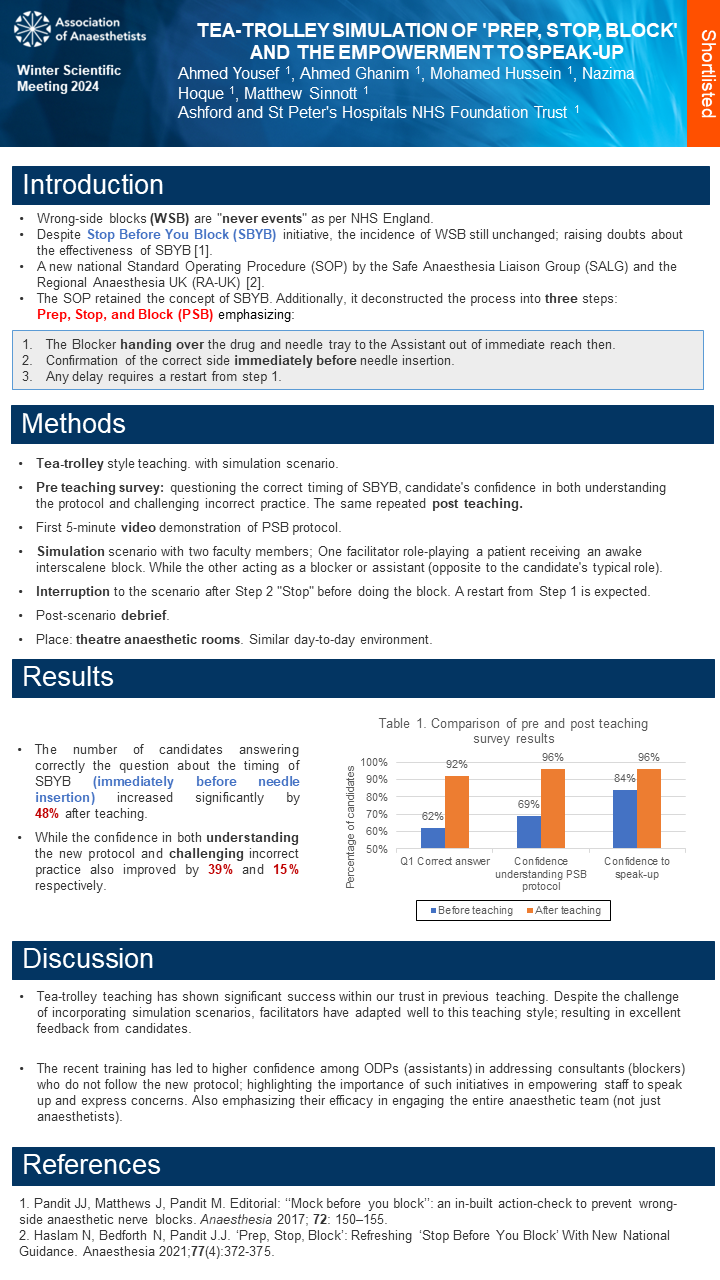
The number of candidates giving correct answer to the time of block performance increased significantly by 48%. While the confidence in both understanding the new protocol and speaking up to challenge incorrect performance also improved by 39% and 15% respectively.
Table 1. Comparison of pre and post teaching survey results.
| (n= 13) | Pre-teaching | Post-teaching |
| Q1 Correct answer | 62% (8) | 92% (12) |
| Confidence understanding PSB protocol | 69% | 96% |
| Confidence to speak-up | 84% | 96% |
Discussion
Tea-trolley teaching has shown significant success within our trust previously. Despite the challenge of incorporating simulation scenarios, facilitators have adapted well to this teaching style, resulting in excellent feedback from candidates. The recent training led to higher confidence among ODPs in addressing consultants not following the new protocol. This highlights the importance of such initiatives in empowering staff to express concerns and emphasizes their efficacy in engaging the entire anaesthetic team beyond just anaesthetists.