
Poster no: 137
.png )
Poster no: 137
137
Implementing the updated Difficult Airway Society (DAS) guidelines [1] requires rapid multidisciplinary team (MDT) upskilling. Traditional simulation training is resource-intensive and may not reach sufficient staff. We therefore implemented a Tea Trolley Teaching (TTT) model to deliver accessible, low-fidelity, workplace-based education [2].
Methods
Three sessions spaced over one week, every month were dedicated to TTT. Sessions were resident-led, with two trainees providing focused teaching so staff could be briefly released from clinical duties. Training was structured to ensure anaesthetists and anaesthetic practitioners of all grades received appropriate exposure and hands-on practice. The content incorporated regional and national best practice, including conference updates. Teaching focused on procedures highlighted in the updated DAS guidelines: emergency front-of-neck access (eFONA), recognition and management of unrecognised oesophageal intubation, airway and gastric ultrasound, Aintree Intubation Catheters (AIC), and familiarisation with the difficult airway trolley.
Results
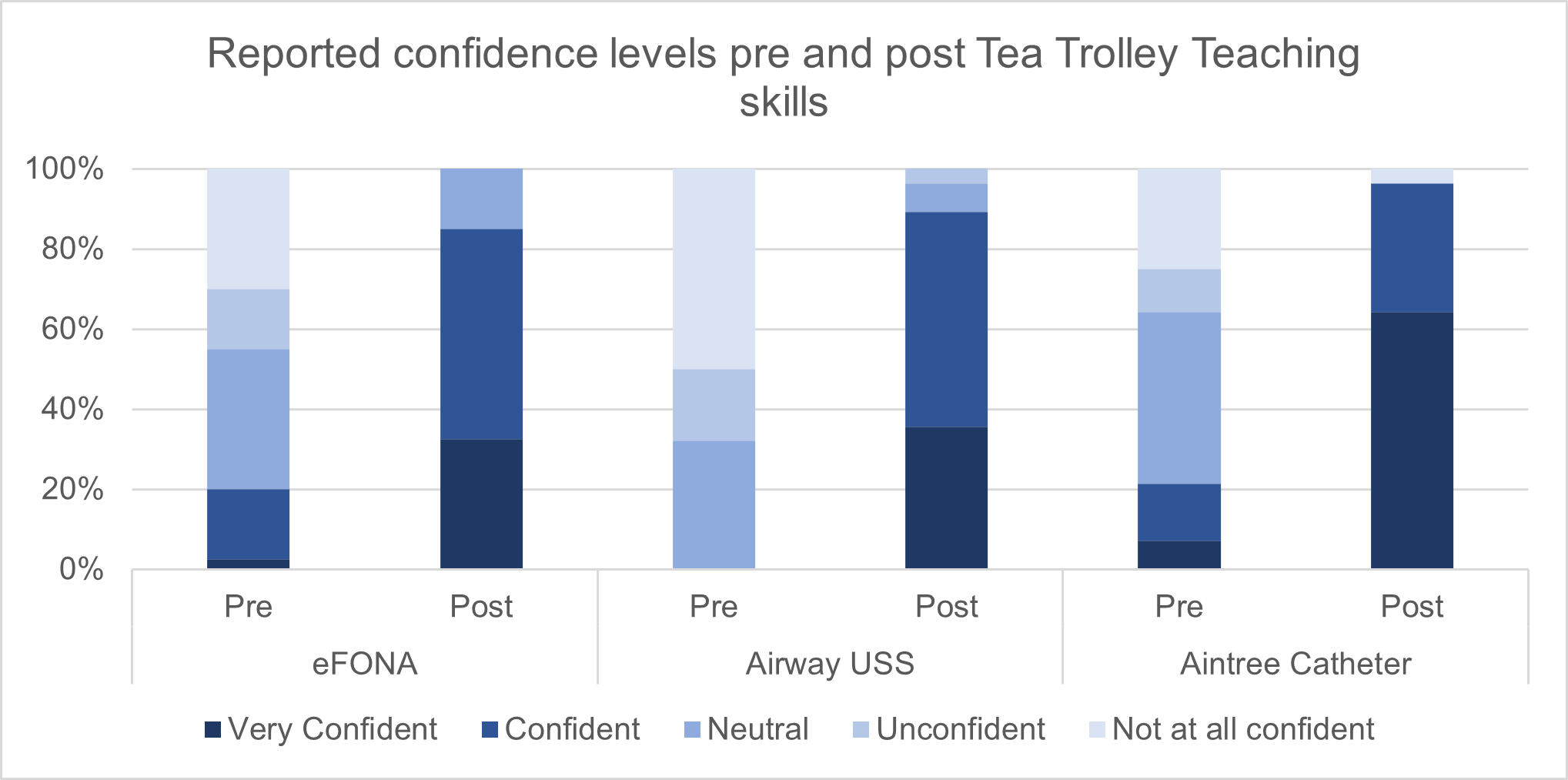
Mean attendance was 35 participants per week, including consultant anaesthetists, fellows/resident doctors, anaesthetic associates, ODPs/anaesthetic practitioners, recovery staff and students. Baseline gaps were identified: 37% had no prior eFONA training, 21.4% had never received AIC training, and 39.3% had no airway ultrasound exposure. Following teaching, awareness of oesophageal intubation guidance increased from 49% to 84%, with improved confidence recognising and challenging oesophageal intubation reported. We found 100% of participants could locate the difficult airway trolley and 96.4% could locate the AIC equipment. Additionally, 78.6% were likely or very likely to introduce airway ultrasound into their practice, and up to 97.5% rated sessions useful or very useful.
Discussion
Compared with traditional simulation training, the TTT model engaged a larger MDT cohort while maintaining small-group learning. It promotes a psychologically safe environment that supports continuous workplace learning, flattens hierarchy by empowering trainees to teach, and encourages professional development. MDT training strengthens communication and teamwork during high-stress airway scenarios. The model proved cost-effective, minimally disruptive to service provision, and is effective in reinforcing practical skills while embedding updated standards of care within the department.