

Poster no: 064
Poster no: 064
064
Category 1 emergency caesarean birth under general anaesthesia is a time-sensitive, life-threatening scenario which requires a multi-disciplinary team of varying experience to reliably perform an essential series of tasks. In this sense it is like a cardiac arrest or a major trauma call. However, unlike these scenarios, no formally agreed standardised process exists.
Methods
We surveyed members of the Obstetric Anaesthetists' Association to see how multi-disciplinary training for the management of category 1 caesarean birth is undertaken in different centres, to identify how frequently problems with the process occur, and to assess the appetite for a standardised approach to aid both management and MDT training.
Results
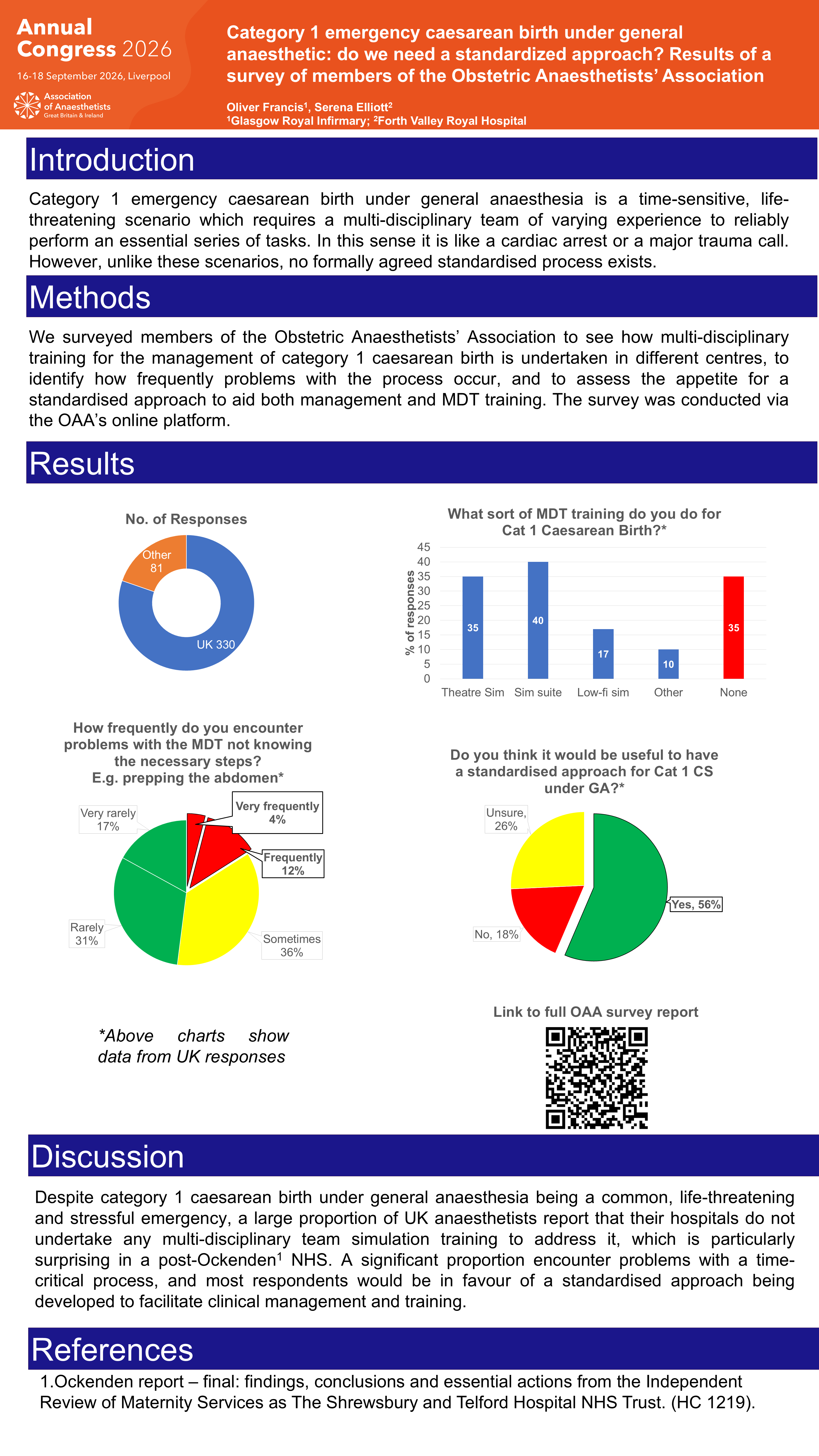
411 members responded to the survey, 330 of whom practice in the UK. 37% reported that no form of multi-disciplinary team training is undertaken at their hospital/trust for category 1 caesarean births; most of the rest do some form of simulation training. 17% of respondents reported problems with the process occurring either 'frequently' or 'very frequently', whilst 47% encountered them 'rarely' or 'very rarely'. 61% said that a standardised approach would be useful; in the subgroup that frequently encountered problems this proportion increased to 84%. Those in favour of a standardised approach emphasised its potential utility in reducing variation, human error, cognitive burden and stress, whilst facilitating a shared mental model across the multi-disciplinary team. Those not in favour of a standardised approach mostly stated concerns about stipulations over anaesthetic technique, and whether a 'one-size-fits-all' approach is inappropriate.
Discussion
Despite category 1 caesarean birth under general anaesthetic being a common, life-threatening and stressful emergency, a large proportion of hospitals in the U.K. do not undertake any multi-disciplinary team simulation training to address it, which is particularly surprising in a post-Ockenden1 NHS. A significant proportion encounter problems with a time-critical process, and most respondents would be in favour of a standardised approach being developed to facilitate clinical management and training.
Acknowledgements
This survey was conducted via the Obstetric Anaesthetists' Association's online platform.