

Poster no: 082
Poster no: 082
082
Contrast-induced nephropathy (CIN) is an acute rise in serum creatinine (SCr) ≥25% or ≥0.5 mg/dL within 72 hours after contrast administration1. Patients with chronic kidney disease (CKD) undergoing coronary angiography are at increased risk of acute kidney injury (AKI). Preventive strategies include risk stratification, contrast dose limitation and post-procedure monitoring, but adherence is variable2.
The objective was to risk stratify patients with CKD using the Maioli risk score3 and evaluate compliance with renal protection strategies, focusing on post-procedure renal monitoring.
Methods
A retrospective evaluation of elective coronary angiography procedures was conducted (Oct–Nov 2022). Patients with eGFR >60 mL/min/1.73 m² and primary coronary angiography were excluded. Compliance with maximum acceptable contrast dose (MACD) and post-procedure SCr monitoring within 48–72 hours was assessed. A structured renal protection pathway was introduced to address gaps. Re-audit was performed (Aug–Oct 2024).
Results
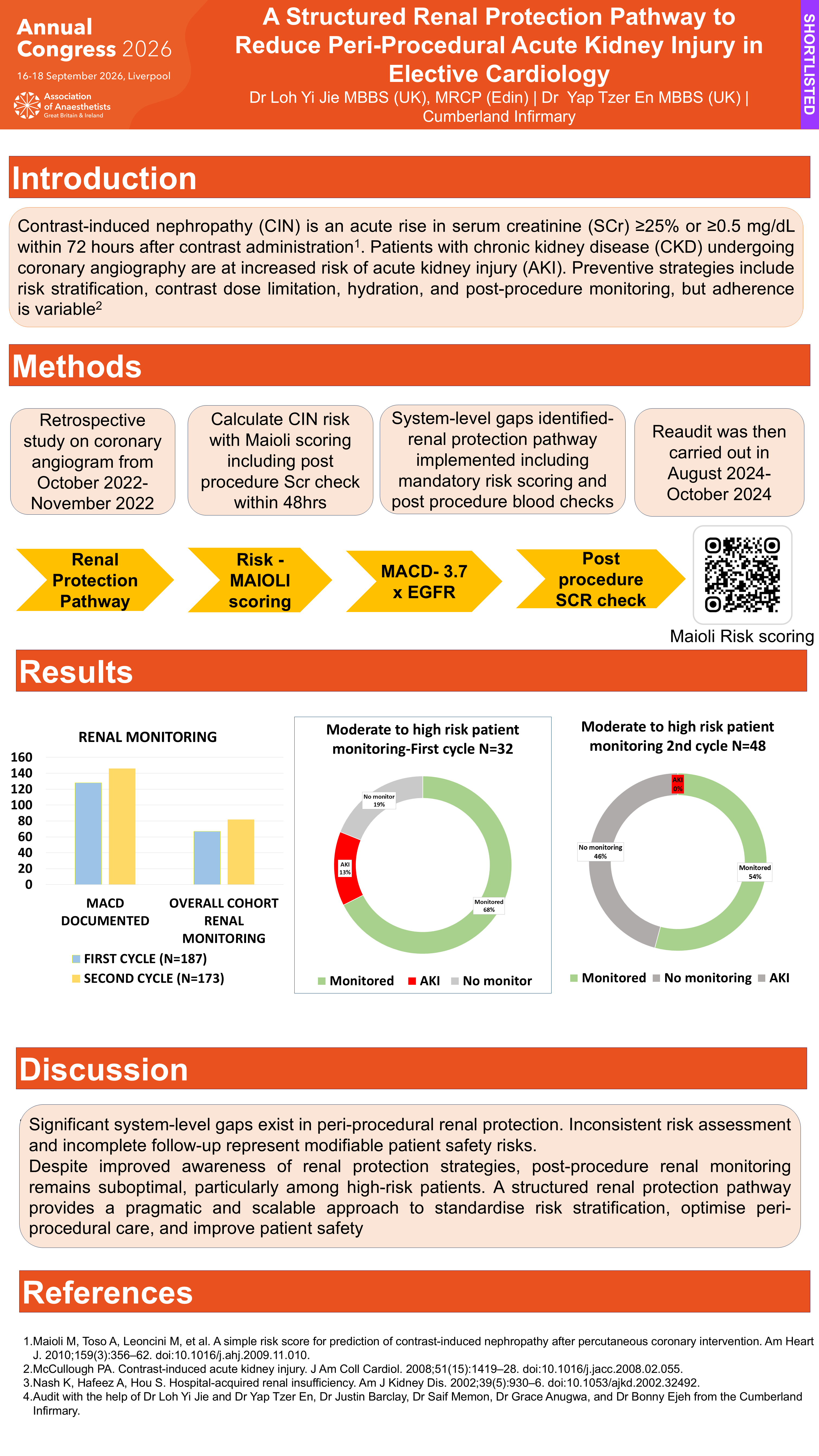
In the initial audit (n=187), 32 patients were moderate-to-high risk for CIN. Among them, 10 patients exceeded MACD, 4 received pre-procedural hydration, and 7 did not undergo post-procedure renal monitoring. Among monitored patients, 5 developed AKI. Overall, 38 procedures exceeded recommended contrast doses.
Following pathway implementation, re-audit of 200 procedures identified 48 moderate-to-high risk patients, including two high-risk. MACD was documented in 188 procedures, with only 1 exceeding the recommended dose. Post-procedure monitoring occurred in 26 of 48 moderate-to-high risk patients and 88 patients overall. Of the two highest-risk patients, one had monitoring. No AKI occurred among high-risk patients during the re-audit period.
Discussion
Post-procedural renal monitoring remains suboptimal despite improved adherence. A structured renal protection pathway standardises risk stratification, optimises contrast use, and enhances patient safety in elective cardiology procedures.