

Poster no: 100
Poster no: 100
100
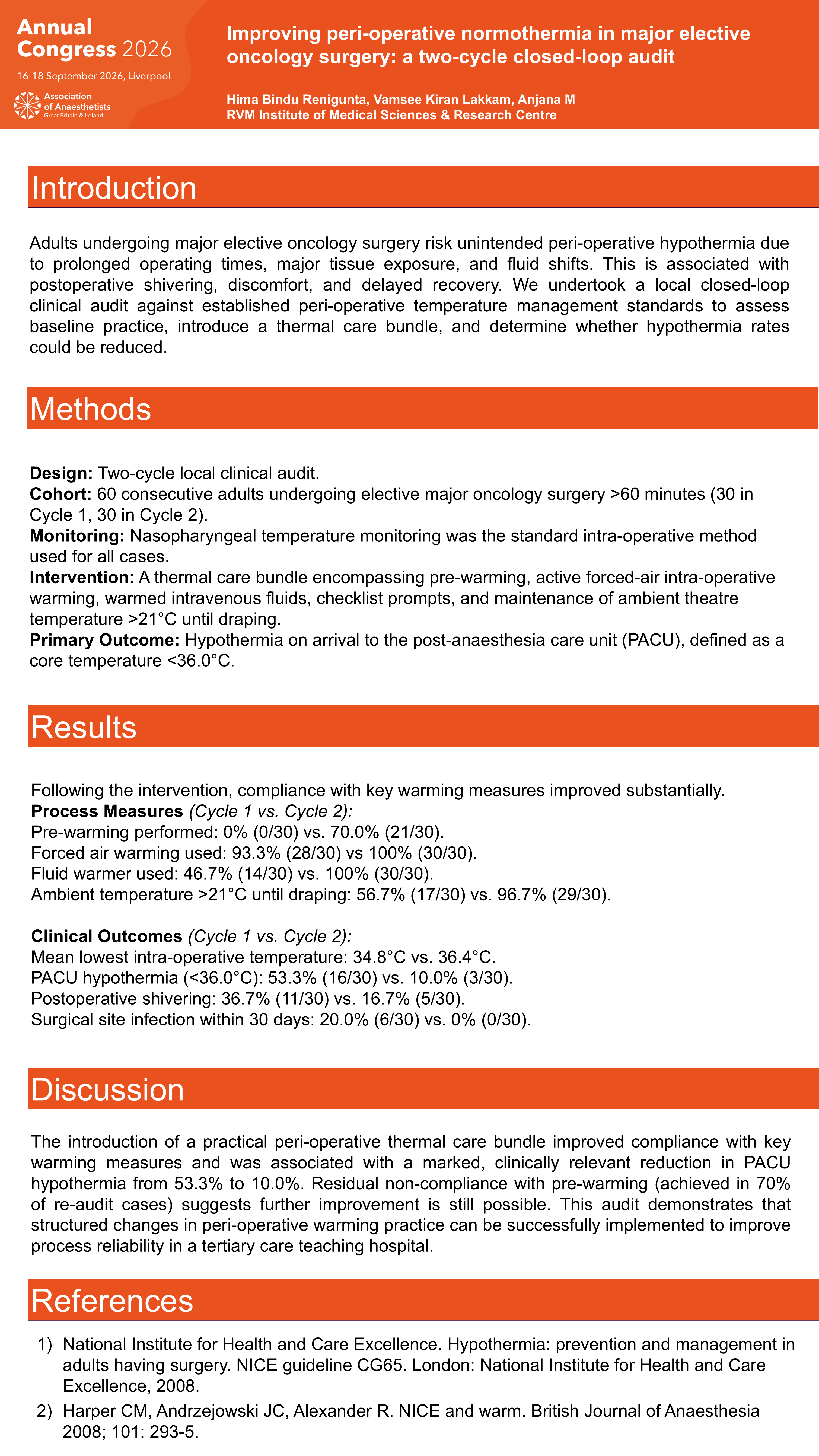
Adults undergoing major elective oncology surgery are at risk of unintended peri-operative hypothermia because of prolonged operating times, exposure and fluid shifts. This is associated with shivering, discomfort and delayed recovery. We undertook a local closed loop audit against established peri-operative temperature management standards in a tertiary care teaching hospital in India undertaking around 40 major oncology cases per month, to assess baseline practice, introduce a thermal care bundle and determine whether postoperative hypothermia could be reduced [1,2].
Methods
Sixty consecutive adults undergoing elective major oncology surgery lasting more than 60 minutes were included. Thirty patients were audited before intervention and 30 after implementation of a peri-operative thermal care bundle, with a one-month interval between cycles to allow implementation.The bundle targeted pre-operative warming, active intra-operative warming, warmed fluids, checklist prompts and temperature monitoring. Data collected included pre-warming, use of forced-air warming, use of a fluid warmer, maintenance of theatre ambient temperature above 21°C until draping, lowest intra-operative temperature, PACU arrival temperature and postoperative shivering. The primary outcome was hypothermia on arrival to PACU, defined as temperature below 36.0°C.
Results
Compliance with key warming measures improved after intervention. Pre-warming improved from 0/30 to 21/30, fluid warmer use from 14/30 to 30/30, and ambient theatre temperature above 21°C until draping from 17/30 to 29/30. Mean lowest intra-operative temperature increased from 34.8°C to 36.4°C, and mean PACU arrival temperature from 35.45°C to 36.55°C. PACU hypothermia fell from 16/30 (53.3%) to 3/30 (10.0%). Postoperative shivering decreased from 11/30 (36.7%) to 5/30 (16.7%).
Discussion
A simple peri-operative thermal care bundle improved compliance with key warming measures and was associated with a marked reduction in hypothermia on arrival to recovery. The reduction in PACU hypothermia from 53.3% to 10.0% is clinically relevant and readily transferable to other units. Residual non-compliance with pre-warming suggests further improvement is still possible. This audit also shows that peri-operative warming standards can be implemented successfully in a tertiary care teaching hospital in India.
Acknowledgements
We thank the theatre, recovery and anaesthetic teams for supporting implementation and data collection.