
Poster no: 143
Poster no: 143
143
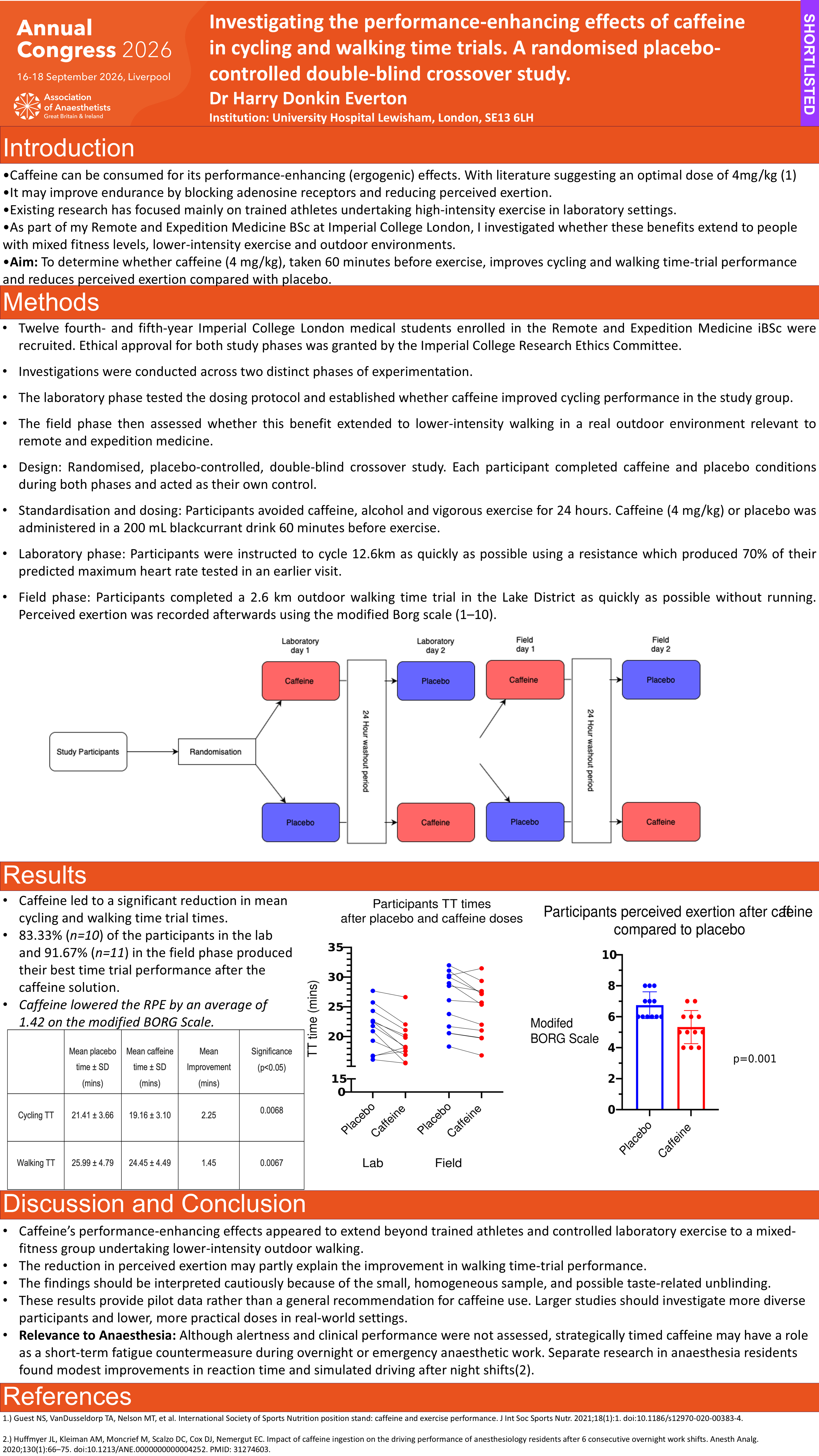
Caffeine has been shown to produce performance-enhancing (ergogenic) effects in endurance exercises, with doses of 4mg/kg consumed an hour before exercise having the greatest efficacy. However, despite caffeine being widely consumed, these effects are mainly studied in elite athletes, in high intensity exercise, and under laboratory conditions. Thus, the purpose of the study is to address gaps in the literature by investigating the ergogenic effect of caffeine in a participant group of mixed physical fitness, in exercises of different intensity, and in laboratory and field settings. It was hypothesised that compared to a placebo, caffeine intake of 4mg/kg will decrease the time taken to complete a cycling (laboratory) and a walking time trial (field) and reduce participants perceived exertion of exercise.
Methods
Using a randomised placebo-controlled double-blind crossover study design, twelve Remote Medicine BSc students (mean ± SD: Age= 22.1 ± 1.4 years; Body mass= 66.4 ± 13.0 kg; VO2max= 38.1 ± 5.7 mL/kg/min) completed a lab phase consisting of a 12.6km cycling time trial and a field phase consisting of a 2.6km walking time trial following standardisation and dosing.
Results
Caffeine intake significantly improved mean cycling time trial performance by 2.25 mins or 10.51% (p=0.0068) and significantly improved mean walking time trial performance in the field by 1.45 mins or 5.93% (p=0.0067). Caffeine also reduced mean perceived exertion by 1.42 on the Modified BORG scale (p=0.001).
Discussion
This is the first study investigating the ergogenic effect of caffeine in low intensity exercise and in the outdoors. The findings may be relevant to individuals looking to benefit from marginal gains in their performance or those trying to reduce their perceived exertion in exercise. Whilst future work is needed to reveal the mechanisms behind caffeine’s ergogenic effect, the results could be used as pilot data for future studies.