

Poster no: 110
Poster no: 110
110
Anaesthetic charts are often poorly completed legal documents. They should provide an accurate and legible record of the patient’s care in line with mandatory guidance from the Royal College of Anaesthetists and the Association of Anaesthetists. This is particularly relevant for trusts that use paper charts, where documentation may be less consistent than electronic records. High-quality documentation supports accurate auditing and research, facilitates effective handover and most importantly, improves patient safety. This project introduced a new anaesthetic chart at Chesterfield Royal Hospital with recommended data fields and was assessed against the previous chart to determine whether documentation standards had improved.
Methods
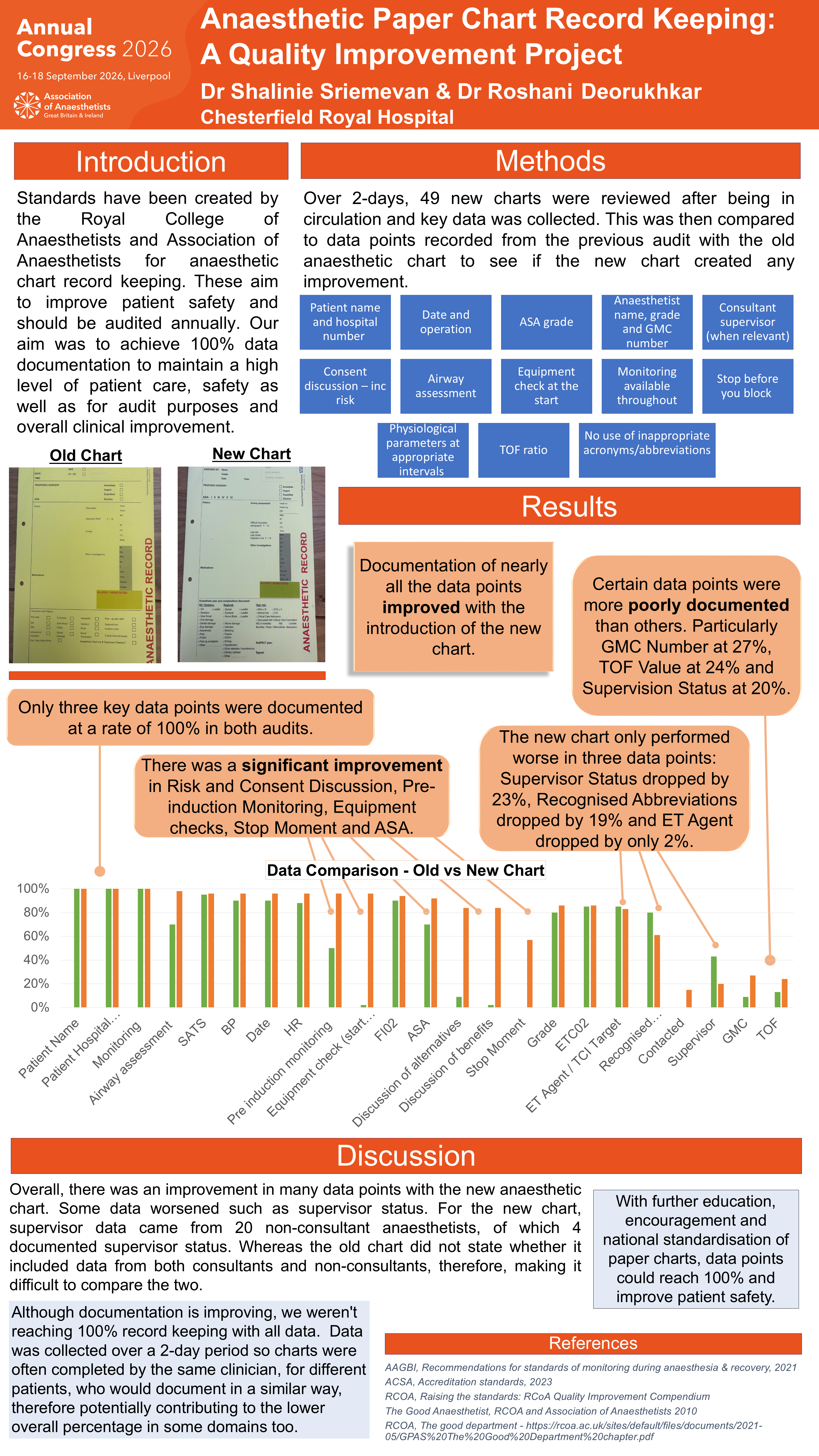
Fifty new anaesthetic charts were reviewed over a 2-day period including both elective and emergency procedures. Each chart was assessed for documentation of mandatory data points and compared with the old chart. Data included patient, anaesthetist, procedural and consent details.
Results
The new anaesthetic chart resulted in improved documentation across all data sets. The only data to achieve 100% completion were patient name, date of birth, hospital number, and monitoring, as with the previous chart. Areas improved to near 100% included: ASA grade, anaesthetist grade, pre-induction monitoring, airway assessment, date, and physiological parameters. The greatest improvements were seen in documentation of ASA grade, airway assessment, and pre-induction monitoring, which increased from 50% to 96%. Poorly documented areas included: GMC number, consultant supervisor details and location, stop moment, end-tidal carbon dioxide and end-tidal agent concentration, TOF ratio, and the use of approved abbreviations.
Discussion
The introduction of the new anaesthetic chart led to an overall improvement in documentation quality. However, several areas still require further improvement. With continued education to complete all sections of the chart, documentation rates may improve further, with the aim of achieving 100% compliance. This chart will provide a useful template for standardising paper anaesthetic charts across trusts, where variation in chart templates can contribute to inconsistent documentation and potential patient safety concerns. By improving paper chart documentation, we hope to support safer practice across trusts.
Acknowledgements
Dr R. Deorukhkar
Dr C. Hirst