

Poster no: 125
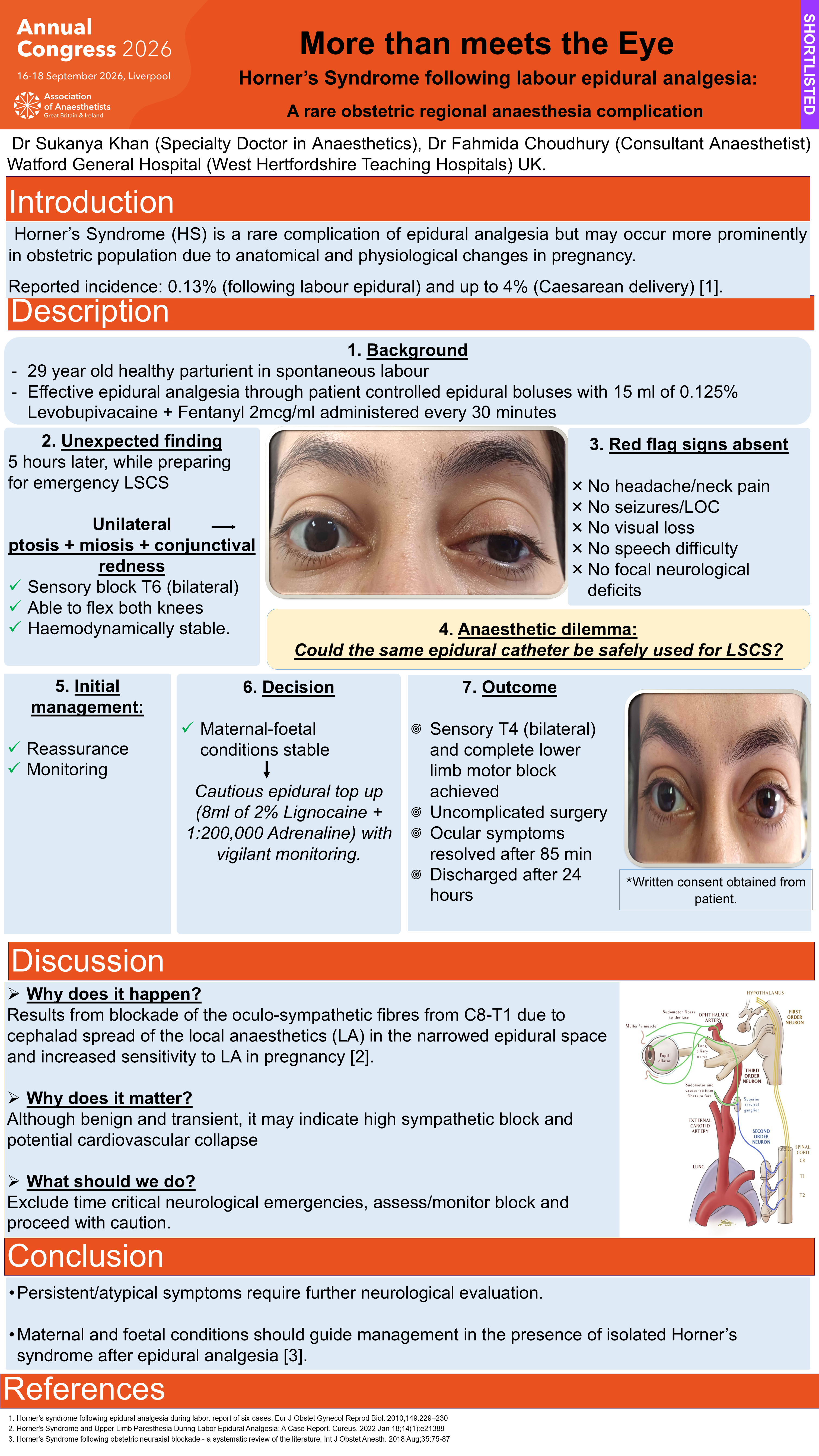
Poster no: 125
125
Horner’s Syndrome (HS) is a rare complication of epidural analgesia but may occur more prominently in obstetric patients due to anatomical and physiological changes in pregnancy. We present an example of HS following labour epidural analgesia in a parturient who subsequently underwent emergency caesarean section (CS) under epidural top-up.
Description
A 29-year-old presented at term in spontaneous labour. An epidural catheter was inserted for labour analgesia between third and fourth lumbar interspace, in a single attempt. An initial epidural dose of 15 millilitre of 0.1% Levobupivacaine with Fentanyl two micrograms/millilitre provided satisfactory analgesia within 20 minutes.Patient controlled epidural analgesia using the same solution was set at 15 millilitre boluses every 30 minutes. After five hours and seven boluses, she was scheduled for an urgent CS. It was then noted that the parturient had left eye ptosis, conjunctival redness and miosis without any visual disturbance. Sensory block was sixth thoracic dermatome bilaterally, with no motor block and stable vital observations. Furthermore, she reported similar transient symptoms with previous labour epidural and was therefore reassured and closely monitored. Epidural top-up of eight millilitres of two percent Lidocaine with 1:200,000 Adrenaline was administered for the CS. After ten minutes, sensory block reached fourth thoracic dermatome bilaterally, with complete motor block. Surgery was completed without any haemodynamic instability or pain. There was complete resolution of ocular symptoms 85 minutes after the last epidural dose. The postoperative period was uneventful, and she was discharged the next day.
Discussion
HS results from blockade of the sympathetic fibres from eighth cervical to first thoracic level resulting in ptosis, anhidrosis, enophthalmos, and miosis. Cephalad spread of the local anaesthetic (LA) due to narrowed epidural space and increased sensitivity to LA due to increased progesterone in pregnancy are attributable causes [1]. Although benign and transient, its presence may indicate high sympathetic block and potential cardiovascular collapse. Persistent symptoms require neurological examination with imaging to exclude other causes of HS. The presence of HS alone should not lead to discontinuation of neuraxial blockade [2]. Maternal and foetal conditions should guide management.
Acknowledgement
No conflicts of interest