

Poster no: 144
Poster no: 144
144
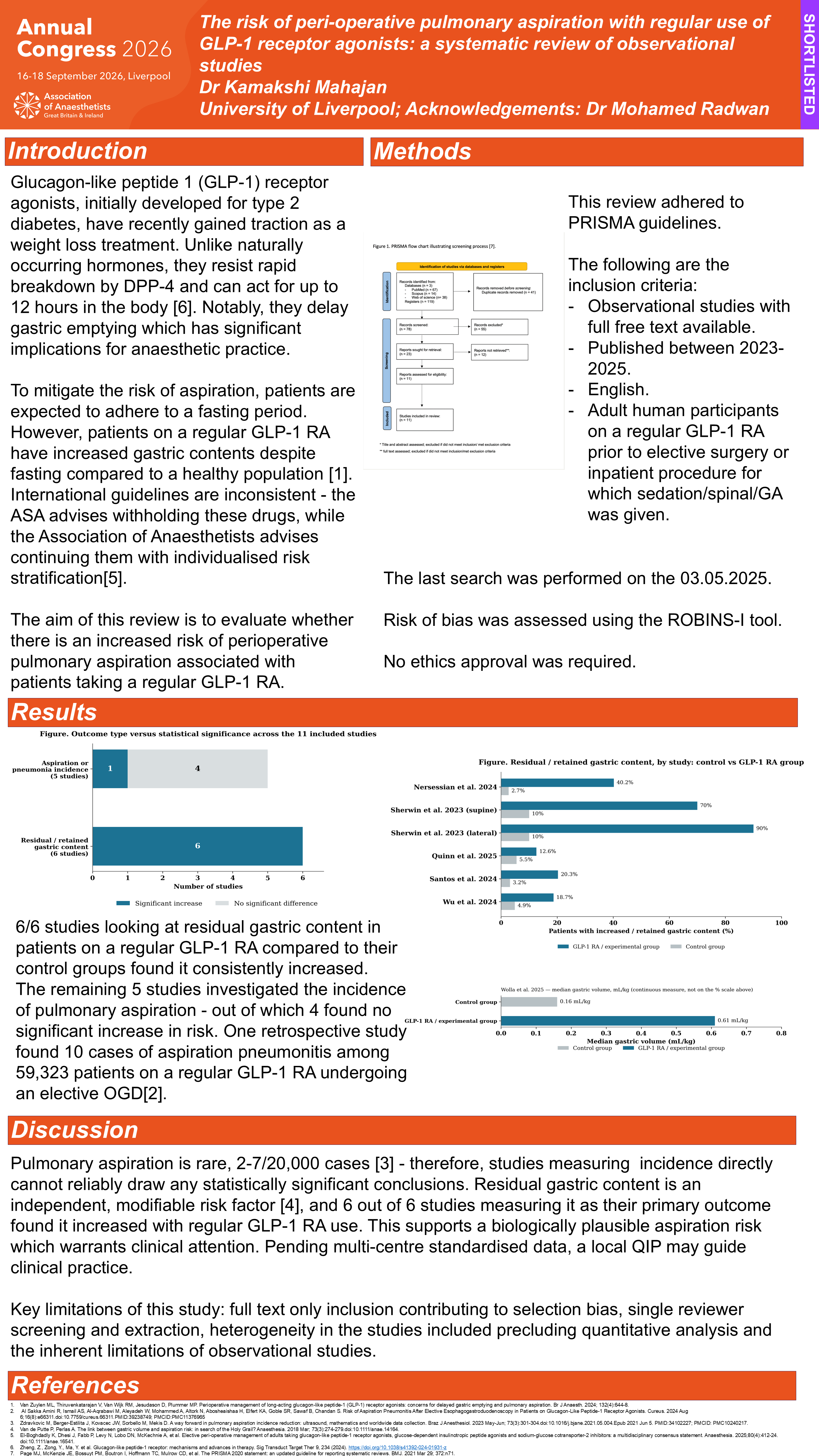
GLP-1 receptor agonists are increasingly prescribed for weight loss. Their principal mechanism of action - delaying gastric emptying - has significant implications for peri-operative aspiration risk. International guidance is inconsistent and high-quality evidence is scarce. We aimed to systematically review observational evidence on peri-operative aspiration risk in GLP-1 RA users.
Methods
A PRISMA-compliant [2] search of PubMed, Scopus and Web of Science was conducted, restricted to English-language observational studies, 2023–2025, in adult human participants. Inclusion was limited to freely available full text, introducing potential selection bias. Of 119 records identified, 78 remained after deduplication; 11 met inclusion criteria. Risk of bias was assessed using the ROBINS-I tool.
Results
All 4 prospective cohort studies employed point-of-care gastric ultrasound to assess residual gastric content; 3 demonstrated a statistically significant increase in GLP-1 RA users versus controls. One prospective cohort study used aspiration incidence as its primary outcome (426 patients), reporting no significant peri-operative aspiration risk. Among the 7 retrospective studies, confirmed aspiration events were rare. One propensity-matched analysis (n=118,646 elective OGD patients) identified aspiration pneumonitis in 0.017% of GLP-1 RA users versus 0% of controls, the only study to demonstrate a significant aspiration signal. Three large retrospective studies (>400,000 patients combined) found no significant increase in postoperative aspiration or acute respiratory failure. Two retrospective studies found significantly increased odds of retained gastric contents (OR 1.92 and 5.8). ROBINS-I assessment revealed serious risk of bias in most studies. Methodological heterogeneity precluded meta-analysis.
Discussion
Consistent prospective evidence of increased residual gastric contents supports a biologically plausible mechanism of peri-operative aspiration risk, warranting clinical attention despite a statistically insignificant aspiration incidence. Single reviewer and selection bias limit certainty. Guidance remains discordant — the ASA recommends withholding GLP-1 RAs preoperatively with point-of-care ultrasound where not withheld; the UK Association of Anaesthetists supports continuation with individualised risk stratification [1]. Pending multi-centre data, a local QIP may guide practice change.
Acknowledgements
Dr Mohamed Radwan