

Poster no: 071
Poster no: 071
071
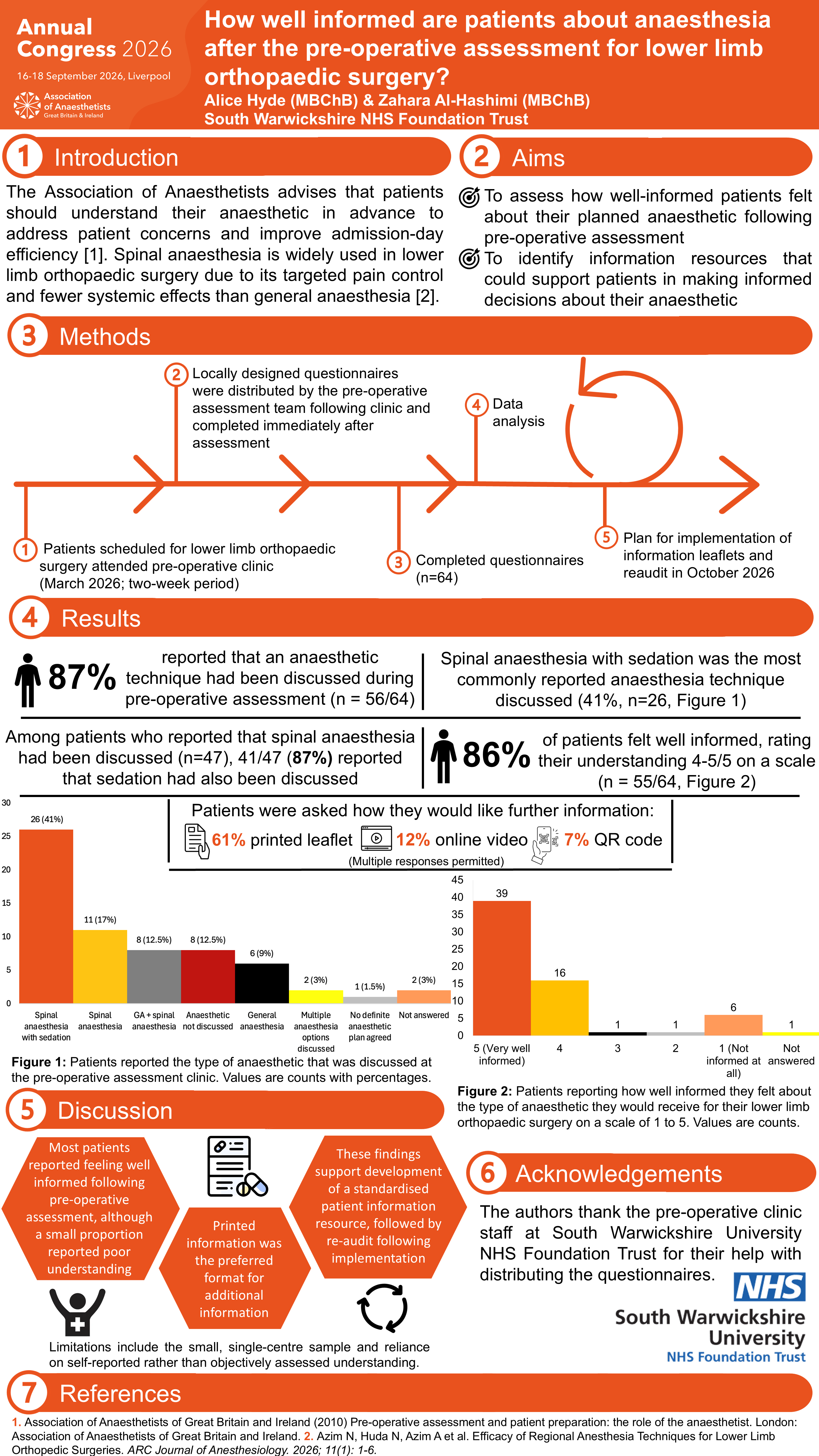
The Association of Anaesthetists advises that patients should understand their anaesthetic in advance to address patient concerns and improve admission-day efficiency [1]. Spinal anaesthesia is widely used in lower limb orthopaedic surgery due to its targeted pain control and fewer systemic effects than general anaesthesia [2]. This quality improvement project, conducted in a DGH, assessed whether patients felt adequately informed about spinal anaesthesia following pre-operative assessment and whether they wanted additional information to support decision-making.
Methods
Data was collected anonymously through questionnaires distributed to 64 patients scheduled to undergo lower limb orthopaedic surgery following their attendance at the pre-operative assessment clinic over a two-week period (March 2026).
Results
Overall, 87% reported that the anaesthetic type had been discussed with them during the pre-operative clinic while 13% indicated that it had not. Patients were asked which anaesthesia options were discussed pre-operatively. Spinal anaesthesia with sedation was most commonly reported (41%, n=26), followed by spinal alone (17%, n=11), both spinal and general (12%, n=8), and general alone (9%, n=6). Patients who were informed about spinal anaesthesia (n=47) also reported discussion of sedation, though six said it was not mentioned. Patients rated how informed they felt regarding their anaesthetic type on a scale of one to five; 85.9% gave a score of four or five (five = fully informed), while 9% (n=6) gave a score of one (not informed at all). Patients were asked how they would like further information. Most preferred a written leaflet (61%), with fewer choosing an online video (12%) or QR code access to written information (7%).
Discussion
Most patients felt informed about their anaesthetic type and reported this was discussed at the pre-operative clinic. Spinal anaesthesia with sedation was the most commonly discussed option. A minority did not feel well informed, suggesting further work is needed to improve understanding. This suggests variation in patient information, highlighting the need for a more standardised explanation of anaesthesia type. Development of a patient information resource is recommended, with a further audit cycle to reassess usefulness and complete the quality improvement cycle.
Acknowledgements
The authors thank the pre-operative clinic staff at South Warwickshire NHS Foundation Trust for their help distributing questionnaires.