

Poster no: 145
Poster no: 145
145
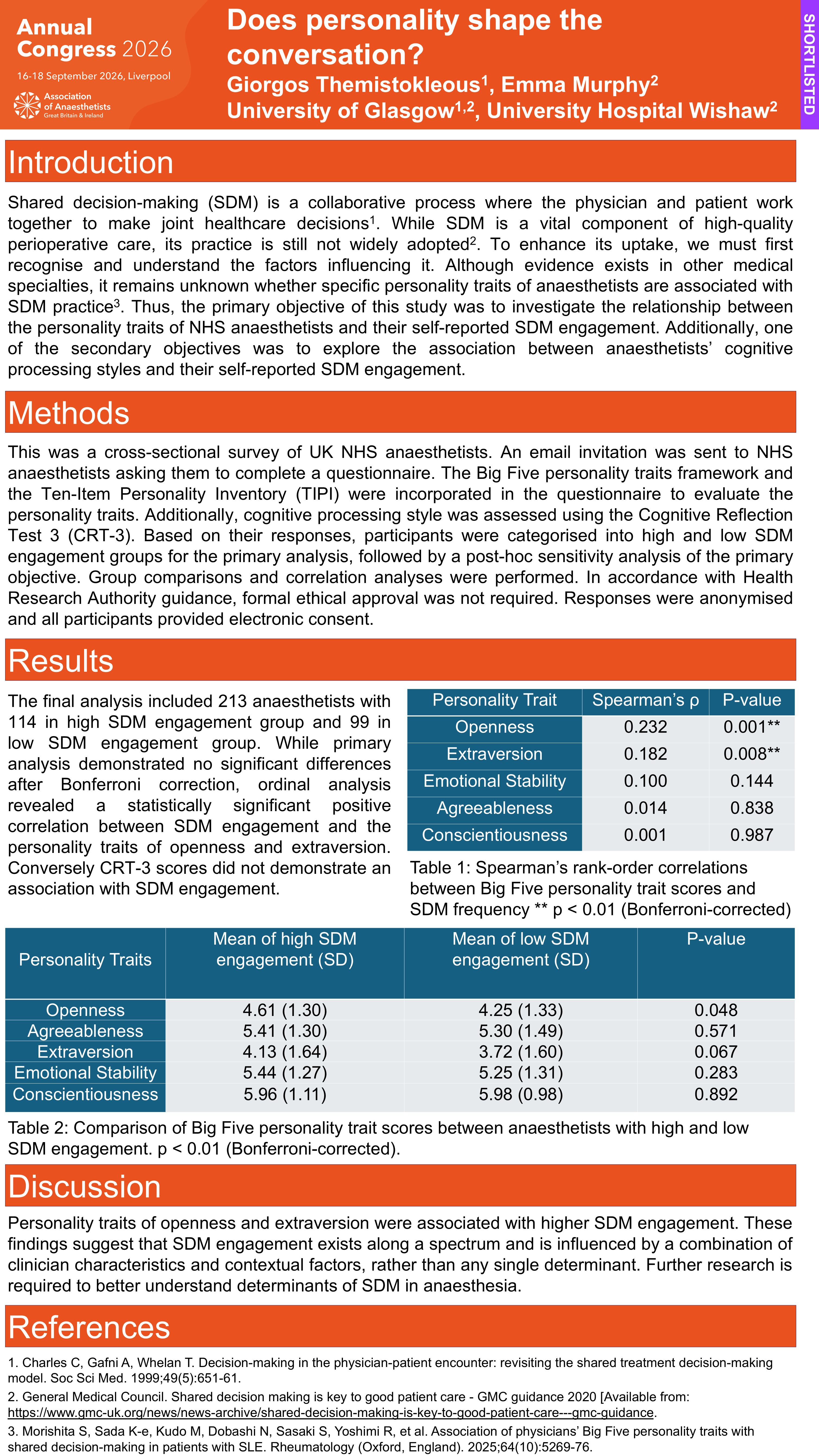
Shared decision-making (SDM) is central to high-quality perioperative care, but adoption remains inconsistent. While clinician-related factors may influence SDM, the role of the personality traits of the anaesthetists who undertake SDM is not well understood. The study aimed to evaluate the association between the personality traits of anaesthetists and their engagement in regular elective SDM.
Methods
A nationally distributed cross-sectional survey of anaesthetists was conducted, demographics and SDM engagement data were collected. Personality was assessed using the Ten-Item Personality Inventory (TIPI) and cognitive processing using the Cognitive Reflection Test 3 (CRT-3). [1,2] Elective SDM engagement was assessed using a four-point self-reported scale (never to frequently) and subsequently grouped into high and low frequency. Group comparisons, correlation analyses, and multivariable logistic regression were performed.
Results
A total of 213 anaesthetists were included in the analysis. SDM engagement varied across the cohort (114 high, 99 low SDM engagement). Anaesthetists who undertook regular SDM consultations reported higher levels of openness (ρ=0.23, p<0.01) and extraversion (ρ=0.18, p<0.01). No association was shown between cognitive reasoning and SDM (p=0.761).
Table 1. Spearman correlations: Big Five trait scores vs. SDM ordinal frequency (0=Never, 1=Occasionally, 2=Regularly, 3=Frequently)
| Personality Trait | Spearman's ρ | P-value |
| Openness | 0.23 | <0.01** |
| Extraversion | 0.18 | <0.01** |
| Emotional Stability | 0.10 | 0.14 |
| Agreeableness | 0.01 | 0.84 |
| Conscientiousness | <0.01 | 0.99 |
**p<0.01 (Bonferroni)
Discussion
Anaesthetists undertaking elective SDM conversations demonstrate higher levels of openness and extraversion than those with lower SDM engagement. These characteristics are key in SDM; openness may facilitate SDM through greater cognitive flexibility and receptiveness to patient perspectives, while extraversion may support the interpersonal engagement required to initiate and sustain SDM discussions. Future work should explore how training and behavioural interventions can support SDM engagement across clinicians, alongside studies incorporating patient-reported and observational measures.
Acknowledgements
We thank the Scottish Perioperative Medicine Society and Dr Suzanne Farrell for assistance distributing the survey.