

Poster no: 039
Poster no: 039
039
Central venous catheter (CVC) insertion is associated with complications such as arterial puncture and pneumothorax. Ultrasound guidance improves success rates and reduces complications [1,2]; however, compliance with guideline recommendations varies in clinical practice. This audit aimed to assess baseline compliance and evaluate the impact of targeted interventions in a tertiary care hospital.
Methods
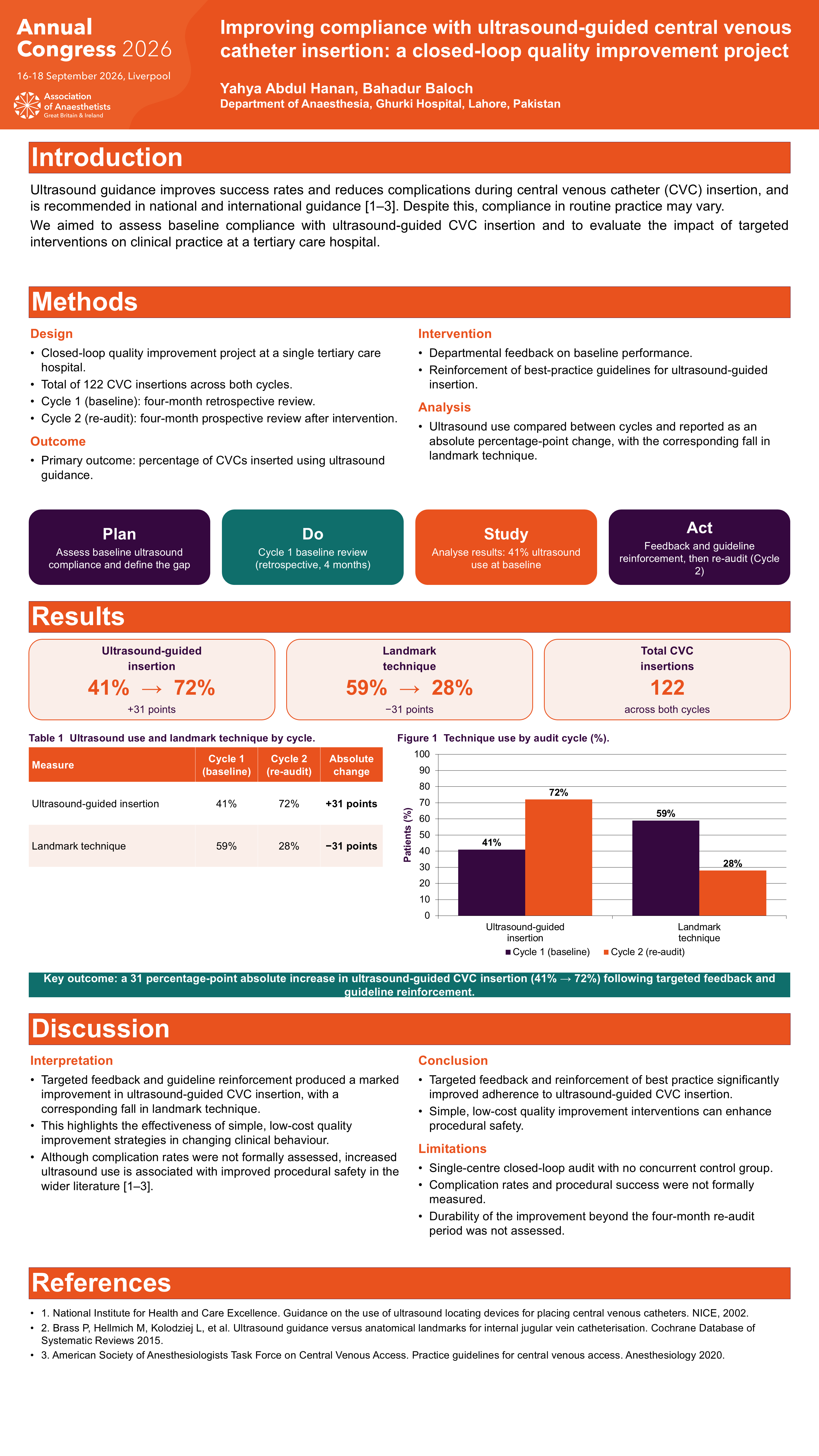
A closed-loop quality improvement project was conducted over two cycles, including 122 patients. Cycle one was a retrospective review over four months assessing ultrasound use during CVC insertion. This was followed by an intervention consisting of departmental feedback and reinforcement of best-practice guidelines. Cycle two was a prospective re-audit over four months using the same parameters. The primary outcome was the proportion of CVCs inserted using ultrasound guidance.
Results
Baseline ultrasound utilisation was 41%. Following intervention, ultrasound use increased to 72%, representing an absolute increase of 31%. Correspondingly, use of the landmark technique decreased from 59% to 28%. Although complication rates were not formally assessed, increased ultrasound utilisation is associated with improved procedural safety.
Discussion
Targeted feedback and reinforcement of guidelines resulted in a significant improvement in ultrasound-guided CVC insertion. This demonstrates that simple, low-cost quality improvement interventions can effectively change clinical practice. Sustained education and institutional support are essential to maintain and further improve compliance with recommended standards [1].
Acknowledgements
We thank the anaesthesia department staff for their contribution to data collection and implementation of practice changes.