

Poster no: 117
Poster no: 117
117
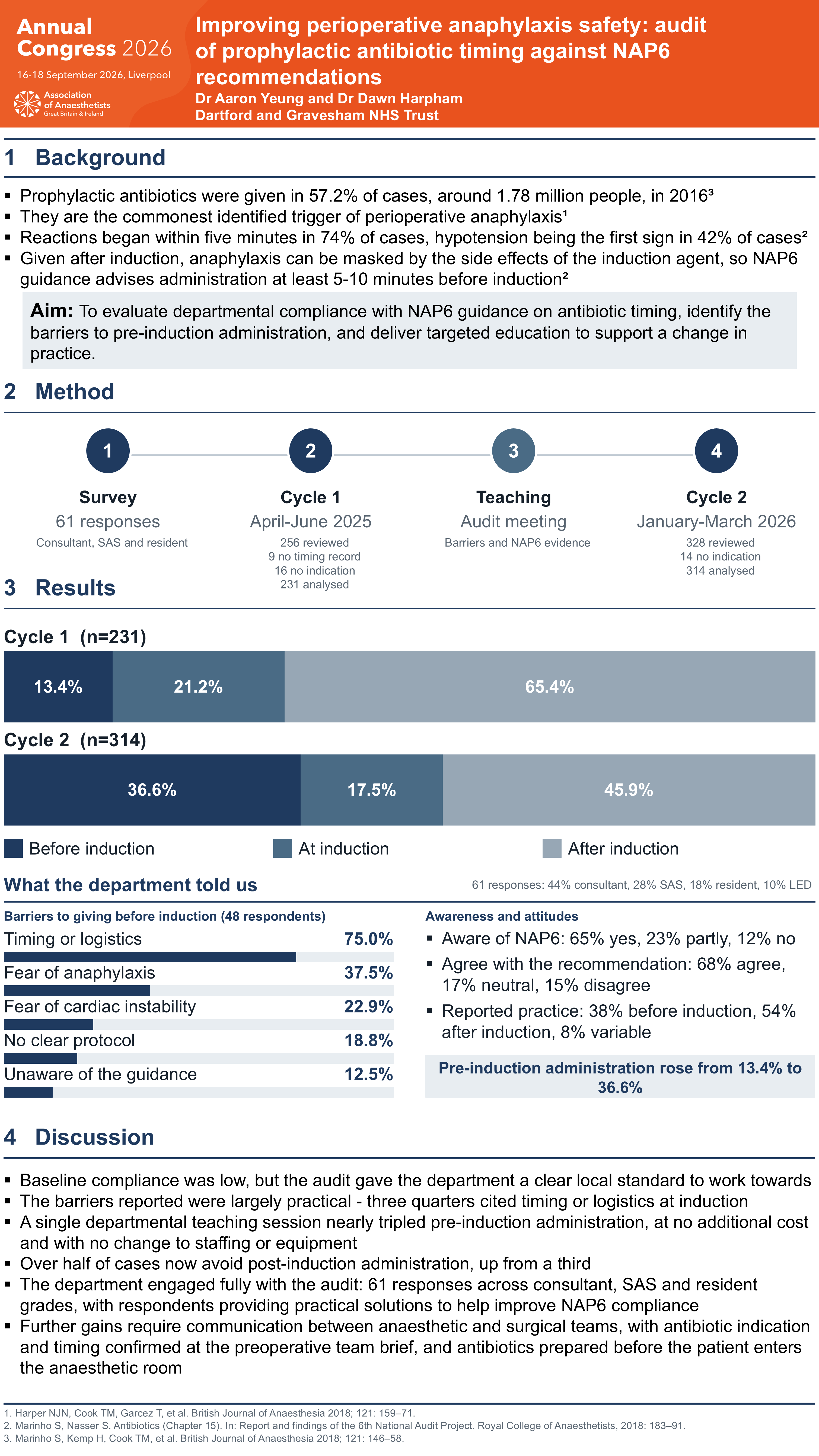
The National Audit Project 6 (NAP6) identified antibiotics to be the leading trigger of peri-operative anaphylaxis [1]. In response, it recommended administering prophylactic antibiotics prior to induction to allow earlier recognition of anaphylaxis and clearer differentiation from the physiological effects of anaesthetic agents, facilitating prompt diagnosis and management of life-threatening reactions to improve patient safety. We aimed to evaluate departmental compliance with NAP6 guidance, identify barriers to implementation and deliver targeted education to support change in practice.
Methods
An initial departmental survey assessed awareness of NAP6 guidance and perceived barriers to pre-induction antibiotic administration. This was followed by a retrospective review of operations between April and June 2025, analysing antibiotic timing. Antibiotic administration was classified as pre-induction, concurrent or post-induction. Induction was defined as the time of propofol or regional anaesthesia administration. Cases where antibiotics were not clinically indicated were excluded. A departmental teaching session was then delivered, addressing the identified barriers and reinforcing the NAP6 evidence base. The audit cycle was subsequently repeated between January and March 2026 using the same methodology.
Results
An 85% response rate was achieved (n=66) including consultants, resident doctors and SAS grades. The most reported barriers were time pressures at induction and lack of preparation (antibiotics not prepared in advance or uncertainty regarding ward administration) cited by 75% of respondents. 93% felt a formal education event would help standardise practice.
In the first audit cycle (n=265), 12% of antibiotics were administered pre-induction, 25% concurrently and 65% post-induction. Following an educational event, the second cycle (n=328) demonstrated improvement, with pre-induction administration increasing to 35%, 17% concurrently and 48% post-induction.
Discussion
Baseline compliance with NAP6 guidance was low, though identified barriers were practical rather than motivational. An educational event nearly tripled pre-induction administration, demonstrating that targeted intervention can drive practice change. Further improvement may be achieved through improved communication between surgical and anaesthetic teams, confirming antibiotic indication and timing during the pre-operative team brief and having regular prompts to reinforce adherence.