
Poster no: 062
Poster no: 062
062
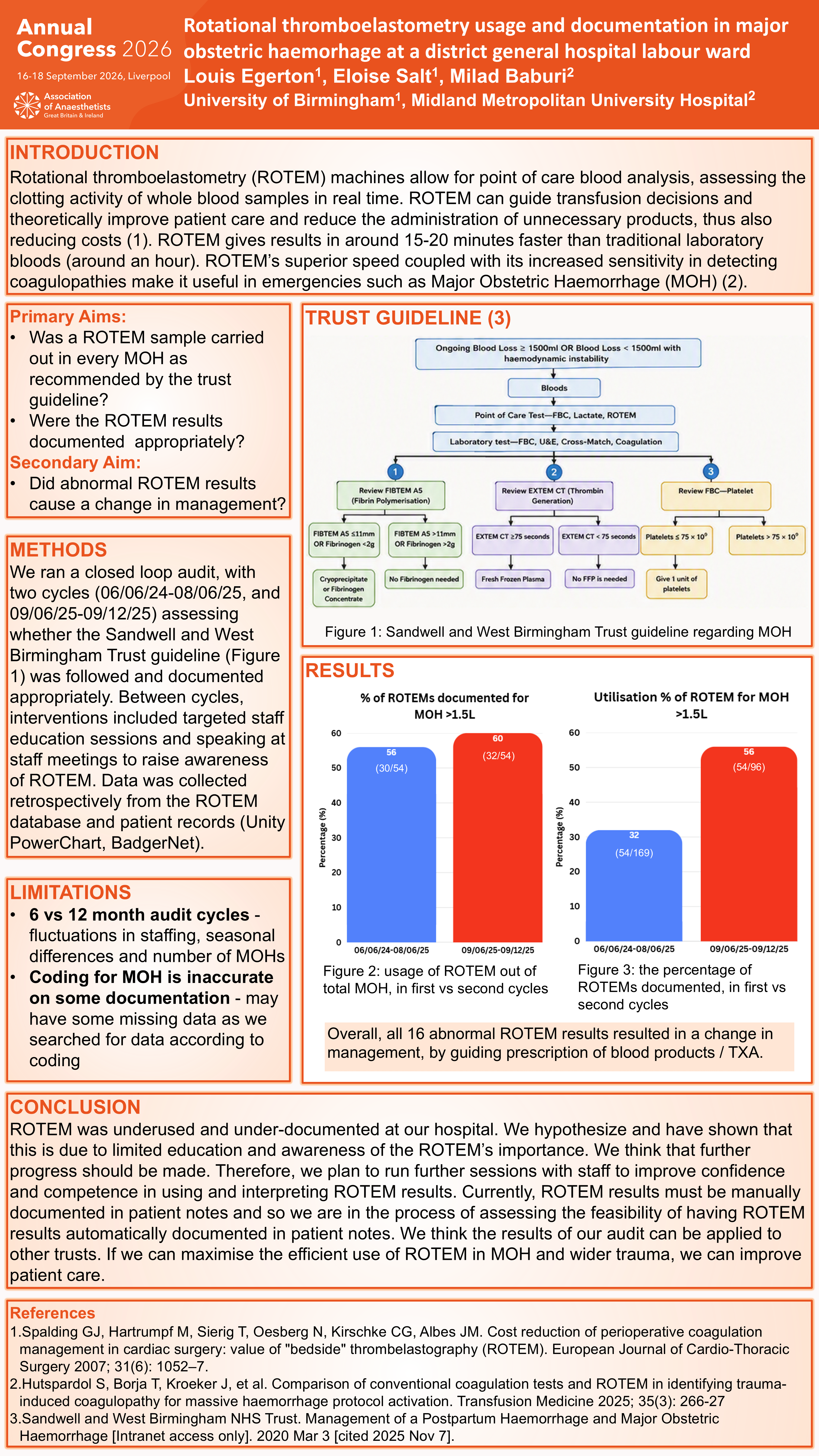
Rotational thromboelastometry (ROTEM) machines allow for point of care blood analysis, assessing the clotting activity of whole blood samples in real time. ROTEM can guide transfusion decisions and theoretically improve patient care and reduce the administration of unnecessary products, thus also reducing costs [1]. ROTEM gives results in around 15-20 minutes faster than traditional laboratory bloods (around an hour). ROTEM’s superior speed coupled with its increased sensitivity in detecting coagulopathies make it useful in emergencies such as Major Obstetric Haemorrhage (MOH) [2].
Methods
We ran a closed loop audit, with two cycles (the first - 06/06/24-08/06/25, and the second - 09/06/25-09/12/25) assessing whether the Sandwell and West Birmingham Trust guideline, which states every MOH with blood loss over 1.5L should have a ROTEM sample run, was followed and documented appropriately. Between cycles, interventions included targeted staff education sessions and speaking at staff meetings to raise awareness of ROTEM. Data was collected retrospectively from the ROTEM database and patient records (Unity PowerChart, BadgerNet).
Results
Between cycles, ROTEM utilisation increased to 56% of MOHs (54/96), compared with 32% (54/169) previously. Documentation improved modestly, with 60% (32/54) of ROTEM results documented in notes versus 56% (30/54) in the initial cycle. In the second cycle, all 16 abnormal ROTEM results (100%) led to changes in blood product management demonstrating ROTEM’s clinical utility.
Discussion
ROTEM was underused and under-documented at our hospital. We hypothesize and have shown that this is due to limited education and awareness of the importance of ROTEM. We think it is important that further progress is made. Therfore, we plan to run further sessions with staff to improve confidence and competence in using ROTEM and interpreting ROTEM results. Currently, ROTEM results must be manually documented in patient notes and so we are in the process of assessing the feasibility of having ROTEM results automatically documented in patient notes. We think the results of our audit can be applied to other trusts. If we can maximise the efficient use of ROTEM in MOH and wider trauma, we can improve patient care.
Acknowledgements
The authors thank Dr Baburi and the obstetrics/anaesthetics team at Midland Metropolitan University Hospital for their support in data collection and implementation of changes.