

Poster no: 095
Poster no: 095
095
Foreign body (FB) ingestion poses a risk of harm, particularly if sharp or corrosive. Endoscopic retrieval is advocated to prevent complications such as obstruction and perforation [1]. Little consensus pertains to the optimal anaesthetic approach. This study examines the safety profile, cost and time effectiveness of different sedation approaches.
Methods
Demographic and endoscopic data including time to procedure, sedation method- conscious sedation (CS) or general anaesthetic (GA), complications and additional procedures were collected from adult patients presenting with FB ingestion between 1 January 2023- 1 February 2026. Food boluses were excluded. The NHS national tariff was utilised to estimate cost differences with an inpatient stay of £562/day (£23.42/hour) and cost of £3284 for minor abdominal procedures under GA, and £1420 for therapeutic gastroscopy under CS; a cost difference of £1864 [2]. A χ2 test was used for group comparisons.
Results
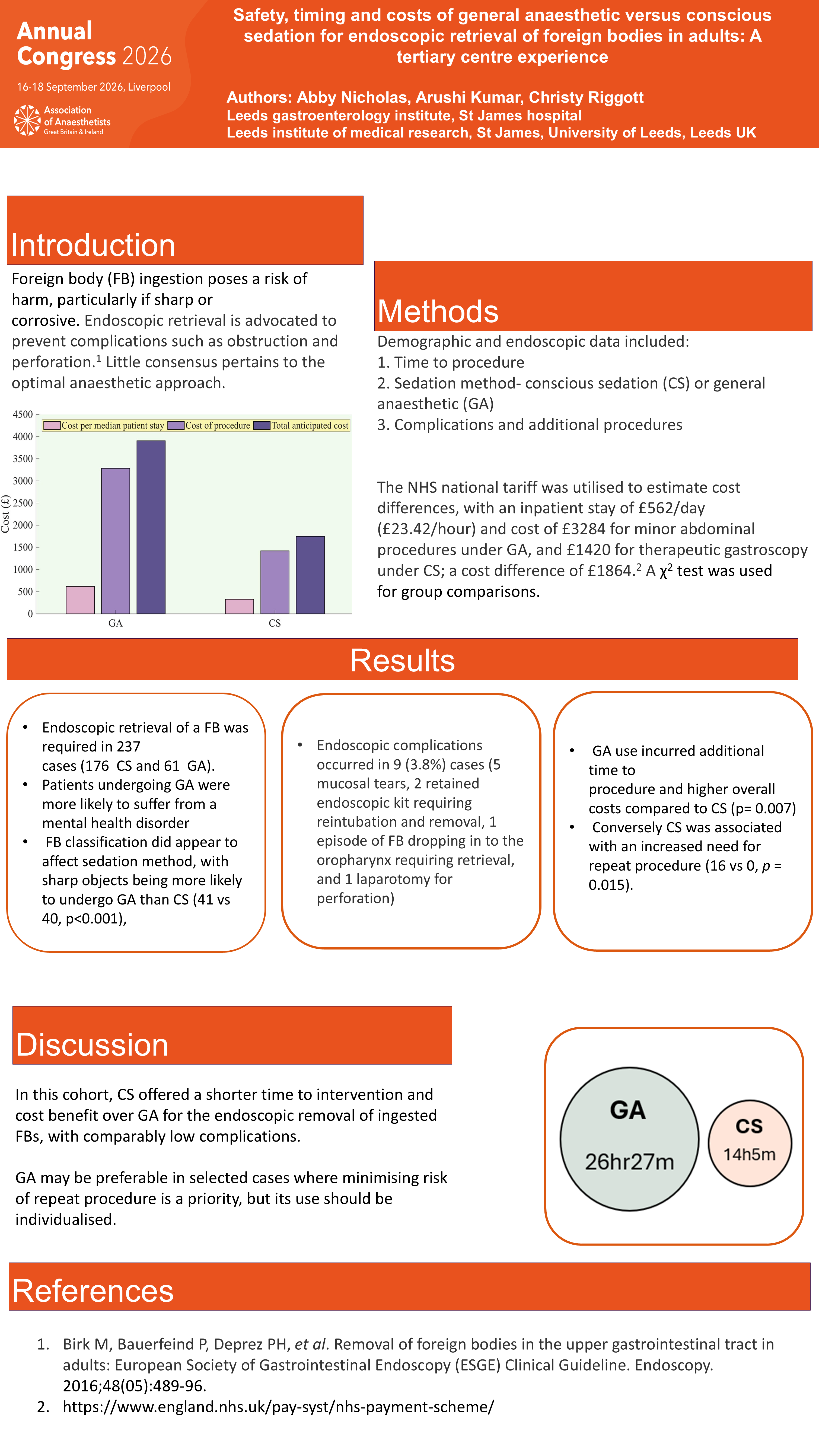
Endoscopic retrieval of a FB was required in 237 cases (176 (74.3%) CS and 61(25.7%) GA). Age and sex were not associated with sedation method, however, patients undergoing GA were more likely to suffer from a mental health disorder (p <0.001). FB classification did appear to affect sedation method, with sharp objects being more likely to undergo GA than CS (41 vs 40, p<0.001), but number of FBs ingested in a single presentation did not (Range 1-50, p=0.98). For CS, the mean doses of midazolam and fentanyl were 3.5mg (Standard deviation (SD) 1.4mg, range 0-7mg) and 82mcg (SD 25.5mcg, range 0-150mcg)respectively, and reversal agents were used in 1 (0.6%) case. Endoscopic complications occurred in 9 (3.8%) cases (5 mucosal tears, 2 retained endoscopic kit requiring reintubation and removal, 1 episode of FB dropping in to the oropharynx requiring retrieval, and 1 laparotomy for perforation) with no significant difference between the two groups (p=0.19). GA use incurred additional time to procedure and higher overall costs compared to CS (p= 0.007) (Table 1). Conversely CS was associated with an increase need for repeat procedure (16 vs 0, p= 0.015).
Discussion
In this cohort, CS offered a shorter time to intervention and cost benefit over GA for the endoscopic removal of ingested FBs, with comparably low complications. GA may be preferable in selected cases where minimising risk of repeat procedure is a priority, but its use should be individualised.
Table 1. Comparison of costs between GA and CS
| Method of sedation | Median time to endoscopy (IQR, Range) | Cost per median patient stay (£) | Cost of procedure (£) | Total anticipated cost (£) |
| GA | 26h27m (13, 1-213) | 619.46 | 3284 | 3903.46 |
| Conscious sedation | 14h5m (39, 1-313) | 329.75 | 1420 | 1749.75 |