

Poster no: 132
Poster no: 132
132
The incidence of melanoma and non-melanoma skin cancers continues to rise. Against this background, even low-level chronic occupational exposures may become increasingly relevant. The clinical significance and extent of occupational UV exposure in operating theatres remains poorly characterised.
Description
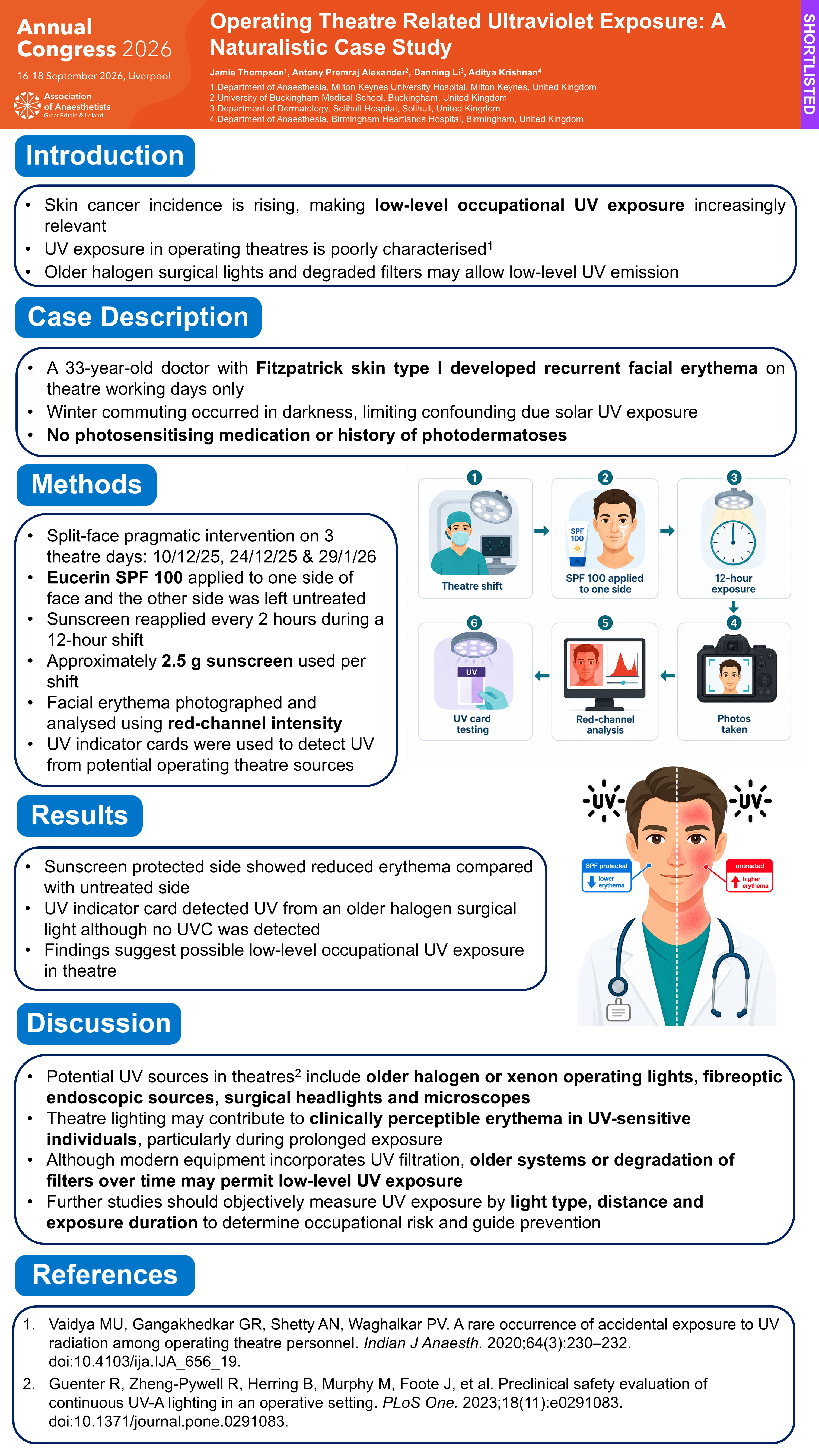
A 33-year-old doctor with Fitzpatrick type I skin reported recurrent facial erythema affecting photo-exposed areas. Symptoms occurred only on working days involving prolonged time in theatre, despite commuting in darkness during winter months. There was no personal or family history of photodermatoses, and no use of photosensitising medication.
To investigate a possible occupational source, a pragmatic split-face intervention was undertaken. High-protection sunscreen (Eucerin SPF 100) was applied to one side of the face before theatre exposure, while the contralateral side was left untreated. This was performed on 10 and 24 December 2025, and 29 January 2026. Sunscreen tubes were weighed, and during a 12-hour shift, approximately 2.5 g of sunscreen was applied at two-hourly intervals.
Facial erythema was documented with contemporaneous photographs; semi-quantitative analysis compared treated and untreated facial regions using red-channel intensity with image-processing software. On split-face sunscreen days, erythema was reduced on the protected side compared with the untreated side.
Further naturalistic observation and statistical analysis were beyond the scope of this pilot case study, but future work could assess duration of exposure, distance from the light source, and type of theatre lighting used.
Discussion
Potential operating theatre UV sources include older halogen or xenon arc lighting systems, fibreoptic endoscopic light sources, surgical headlights, and microscopes, all of which may emit low levels of UV despite filtration. Although modern equipment is designed to minimise UV emission, filter degradation and prolonged close-range exposure may permit low-level exposure.
The authors detected UV using a SaiTech UV detection card from an older halogen diffraction-type operating light, although no UVC was detected. This case suggests that theatre lighting may contribute to clinically perceptible erythema in UV-sensitive individuals. Further objective UV measurement in theatre environments is warranted to define occupational risk and guide prevention.