

Poster no: 122
Poster no: 122
122
Deliberate foreign body ingestion is strongly associated with self-harm and frequently requires endoscopic retrieval. Disposable vapes represent an emerging, unreported class of foreign bodies with distinct hazards: length often exceeding 5 cm; a smooth, low-friction polymer casing resistant to standard grasping instruments; and an integral lithium-ion battery at risk of rupture, thermal injury, and caustic exposure during forced extraction. In an uncooperative patient, these features render a routine endoscopic procedure a high-risk shared-airway scenario for which anaesthetic guidance remains limited [1]. Current ESGE guidelines do not address device-specific risks such as lithium-ion batteries or low-friction casings in uncooperative patients [2].
Description
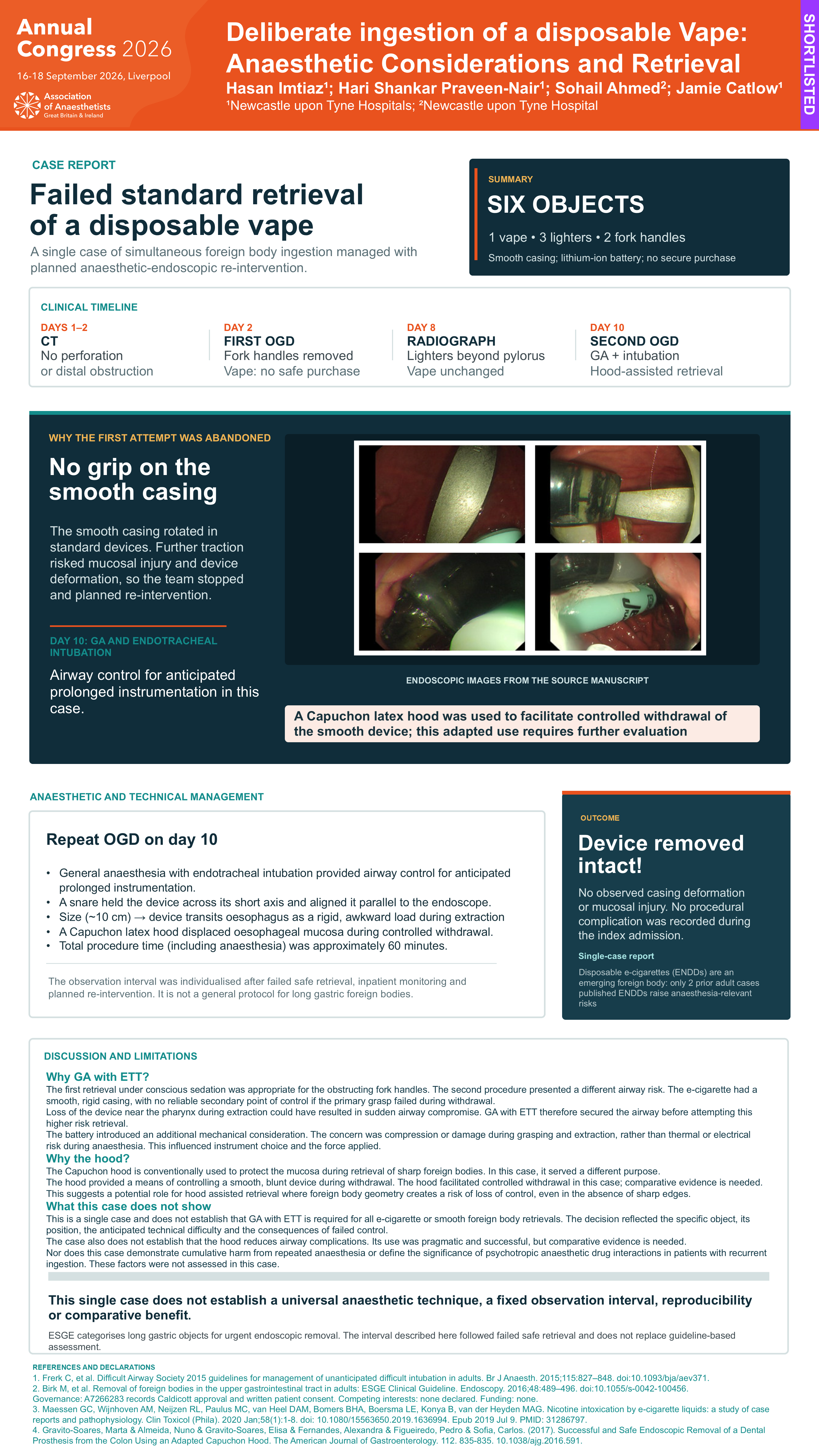
A 25-year-old woman detained under the Mental Health Act with emotionally unstable personality disorder ingested a disposable vape, three lighters, and two fork handles. Index endoscopy under conscious sedation relieved pyloric obstruction from the fork handles; vape retrieval failed because the smooth casing precluded instrument purchase, and traction was deemed unsafe given the risk of mucosal injury and battery deformation. Imaging excluded obstruction and perforation; conservative management was pursued. Following spontaneous passage of the lighters, definitive retrieval was undertaken on day 10 under general anaesthesia with endotracheal intubation. Secured airway control enabled prolonged instrumentation; a Capuchon latex hood mounted on the gastroscope tip displaced oesophageal mucosa during withdrawal, allowing atraumatic extraction.
Discussion
Disposable vapes constitute a high-risk, previously undescribed foreign body class with direct implications for anaesthetic planning. This case yields three practice points. The choice between sedation and general anaesthesia should be made prospectively based on device and patient risk factors: device length exceeding 5 cm, smooth casing, battery presence, and impaired patient cooperation. Endotracheal intubation is essential when prolonged or forceful oropharyngeal manipulation is anticipated. The Capuchon latex hood, conventionally reserved for sharp foreign bodies, can be reproducibly extended to smooth, low-friction devices by creating a protective mucosal interface during withdrawal. Current guidelines do not address this.