

Poster no: 099
Poster no: 099
099
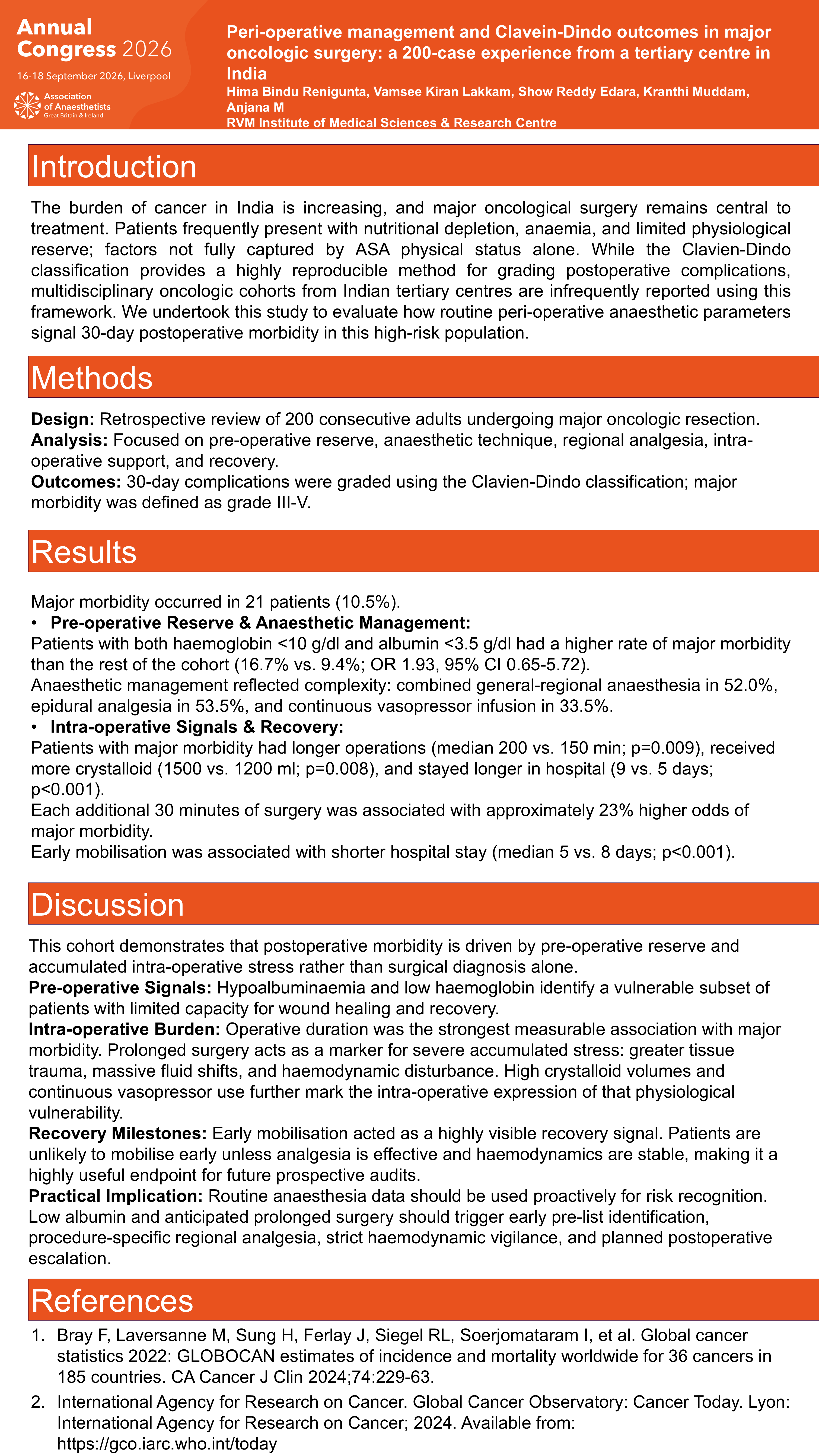
Major oncologic surgery in Indian tertiary centres often involves patients whose risk is not fully captured by the operation planned or the ASA grade assigned. The recurring anaesthetic concern is more specific: low haemoglobin, poor nutritional reserve and long open surgery meeting in the same patient.
Methods
We reviewed 200 consecutive adults undergoing major oncologic resection. Thirty-day complications were graded using the Clavien-Dindo classification [1]; major morbidity was grade III-V. Analysis focused on pre-operative reserve, anaesthetic technique, regional analgesia, intra-operative support and recovery. Univariable testing and a restricted logistic model were used because major morbidity events were few.
Results
Major morbidity occurred in 21 patients (10.5%). ASA physical status alone did not clearly separate patients who developed major morbidity from those who did not. Patients with both haemoglobin <10 g.dl-1 and albumin <3.5 g.dl-1 had a higher rate of major morbidity than the rest of the cohort, although this was not statistically significant (16.7% vs. 9.4%; OR 1.93, 95%CI 0.65-5.72) [2]. The more consistent signal was operative exposure. Patients with major morbidity had longer operations (median 200 vs. 150 min; p=0.009), received more crystalloid (1500 vs. 1200 ml; p=0.008) and stayed longer in hospital (nine vs. five days; p<0.001). Each additional 30 min of surgery was associated with approximately 23% higher odds of major morbidity. Anaesthetic management reflected the complexity of predominantly open cancer surgery: combined general-regional anaesthesia was used in 52.0%, epidural analgesia in 53.5%, and continuous vasopressor infusion in 33.5%. Early mobilisation was associated with shorter hospital stay (median five vs. eight days; p<0.001).
Discussion
This Indian tertiary-centre cohort suggests that postoperative morbidity after major oncologic surgery is signalled before induction and shaped during anaesthesia. Low haemoglobin and albumin identified a small group carrying disproportionate morbidity; prolonged surgery, fluid requirement and vasopressor-supported anaesthesia marked the intra-operative expression of that risk. This supports pre-list identification of low-reserve patients, procedure-specific regional analgesia, closer haemodynamic vigilance, planned postoperative escalation and active protection of early mobilisation.
Acknowledgements
The authors thank the anaesthesia, theatre and surgical oncology teams.