

Poster no: 088
Poster no: 088
088
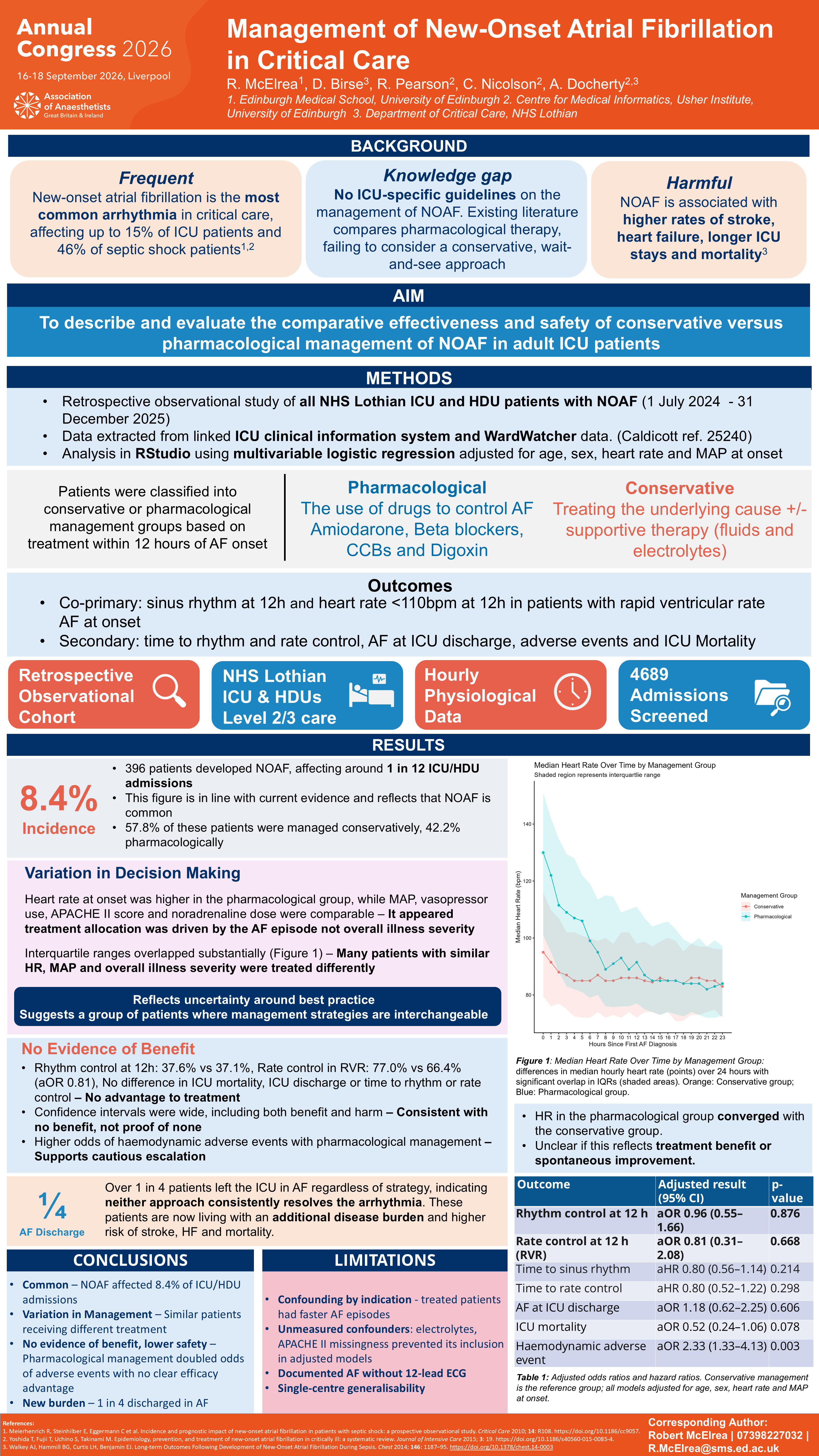
New-onset atrial fibrillation (NOAF) is the most common arrhythmia in ICU, affecting up to 15% of patients and 46% in septic shock [1,2]. Existing literature compares pharmacological therapies, failing to address whether pharmacological intervention is superior to a conservative, wait-and-see approach. We aimed to evaluate the comparative effectiveness and safety of conservative versus pharmacological management of NOAF in adult ICU patients.
Methods
We conducted a retrospective observational cohort study of adult NHS Lothian ICU and HDU patients with NOAF (1 July 2024 – 31 December 2025), using electronic health records. Patients were classified into conservative or pharmacological groups based on treatment within 12 h of onset. Primary outcomes were rhythm and rate control at 12 h. Secondary outcomes included time to rhythm and rate control, discharge in AF, haemodynamic adverse events and ICU mortality. Multivariable logistic regression adjusted for age, sex, heart rate and blood pressure at onset.
Results
Of 4,689 patients, 396 (8.4%) developed NOAF; 42% were pharmacologically managed. Amiodarone was most commonly used (n = 98/167, 58.7%). Blood pressure and vasopressor use at onset did not differ between conservative and pharmacological groups, but heart rate at onset was higher in the pharmacological group. Sinus rhythm at 12 h (aOR 0.96, p = 0.876) and rate control (aOR 0.81, p = 0.668) were similar between groups. In total, 26.8% of patients were discharged in AF, with no group differences. No differences were observed in ICU mortality, time to rhythm or rate control. Pharmacological management was associated with higher odds of haemodynamic instability (aOR 2.33, p = 0.003).
Discussion
The 8.4% incidence confirms NOAF as a frequent critical care complication. Despite similar haemodynamic profiles, management varied considerably. Treatment allocation appeared driven by heart rate at onset rather than illness severity. However, substantial overlap in heart rates between groups implies the decision to treat was often discretionary, reflecting uncertainty around best practice. Over a quarter of patients leaving the ICU in AF creates a new disease burden unaddressed by either approach. The higher rate of haemodynamic adverse events with pharmacological management argues for careful agent selection. A randomised controlled trial is needed where clinical equipoise exists.
Acknowledgements
The authors thank the NHS Lothian critical care team and ICU Heart.