
Poster no: 051
Poster no: 051
051
Discussion
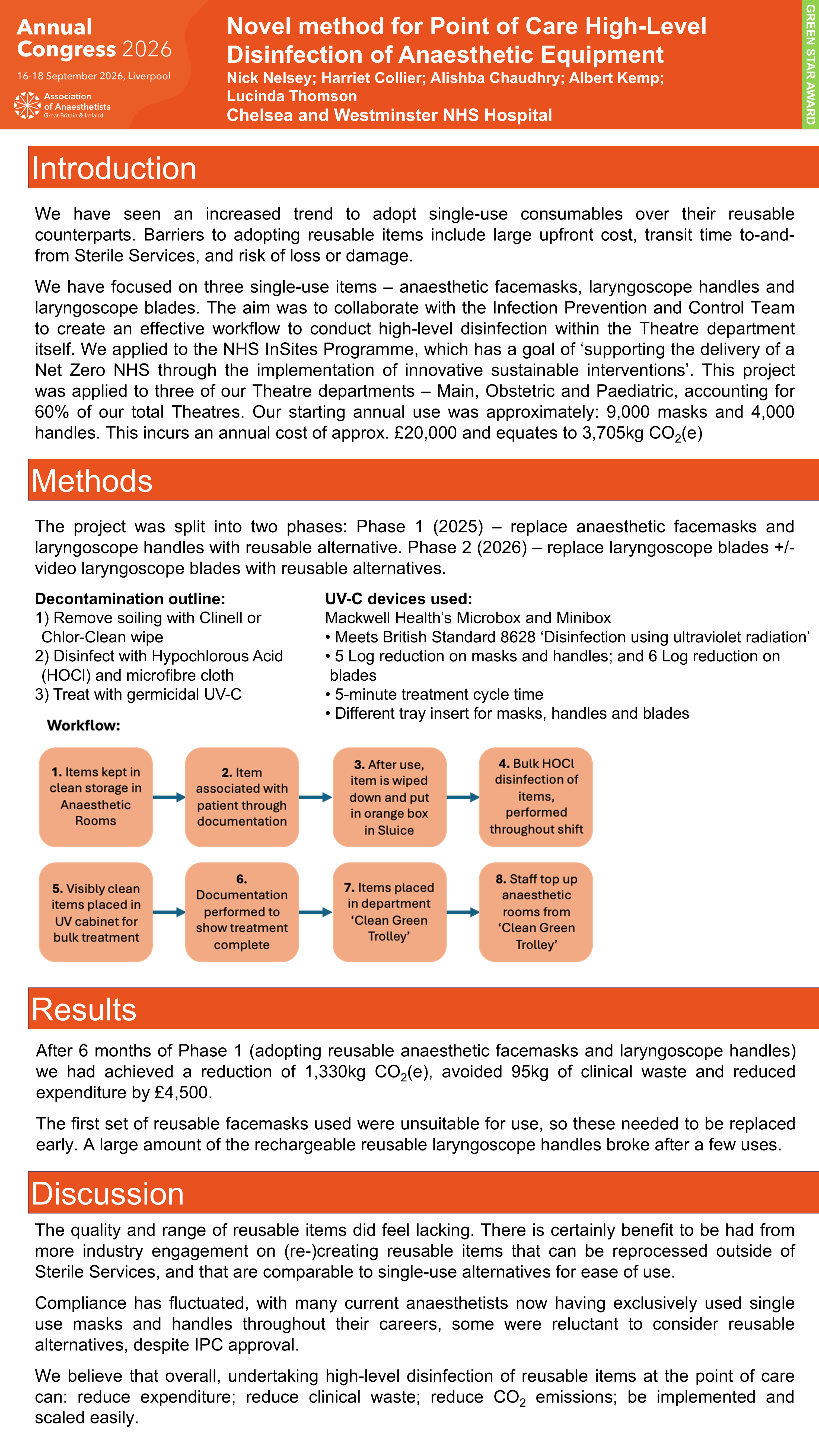
Approximately 2.7 million single-use plastic anaesthetic masks are thrown away annually across NHS England, with an associated carbon footprint of 945 tonnes CO2e. The single-use laryngoscope footprint is estimated to be of a similar magnitude. Currently, Chelsea and Westminster NHS Foundation Trust only use single-use anaesthetic masks and laryngoscope handles in their theatres.
Methods
The evaluation will use evidence collected through the use of the Minibox-HD2 taking place in Chelsea and Westminster Hospital theatres. This intervention completely aligns with the Design for Life Roadmap published in 2024 by the DHSC, which aims to eliminate all avoidable single-use Medical technology from the NHS. To achieve this aim, new methods of reprocessing and decontamination are needed to ensure that re-use can be achieved without any compromise to patient safety. The Minibox-HD2 provides an alternative; a new decontamination method for re-usable medical devices based around new generation solid-state germicidal UV-C. This technology is compact and can be used at the point of care. Both anaesthetic masks and laryngoscope handles have been shown to be effectively decontaminated using this process against bacteria, yeast and fungi, sporicidal, mycobacterial, and virucidal challenges.
Results
After much planning and preparation, the intervention went live on the 2nd October 2025. It was introduced in Main theatres and in Paediatric theatres to start, with labour wards to be introduced downstream. Additionally, the intervention has started with laryngoscope handles first, and this will continue for 4 weeks so that colleagues can get used to the workflow, with the intention of then adding in the reusable masks.