

Poster no: 043
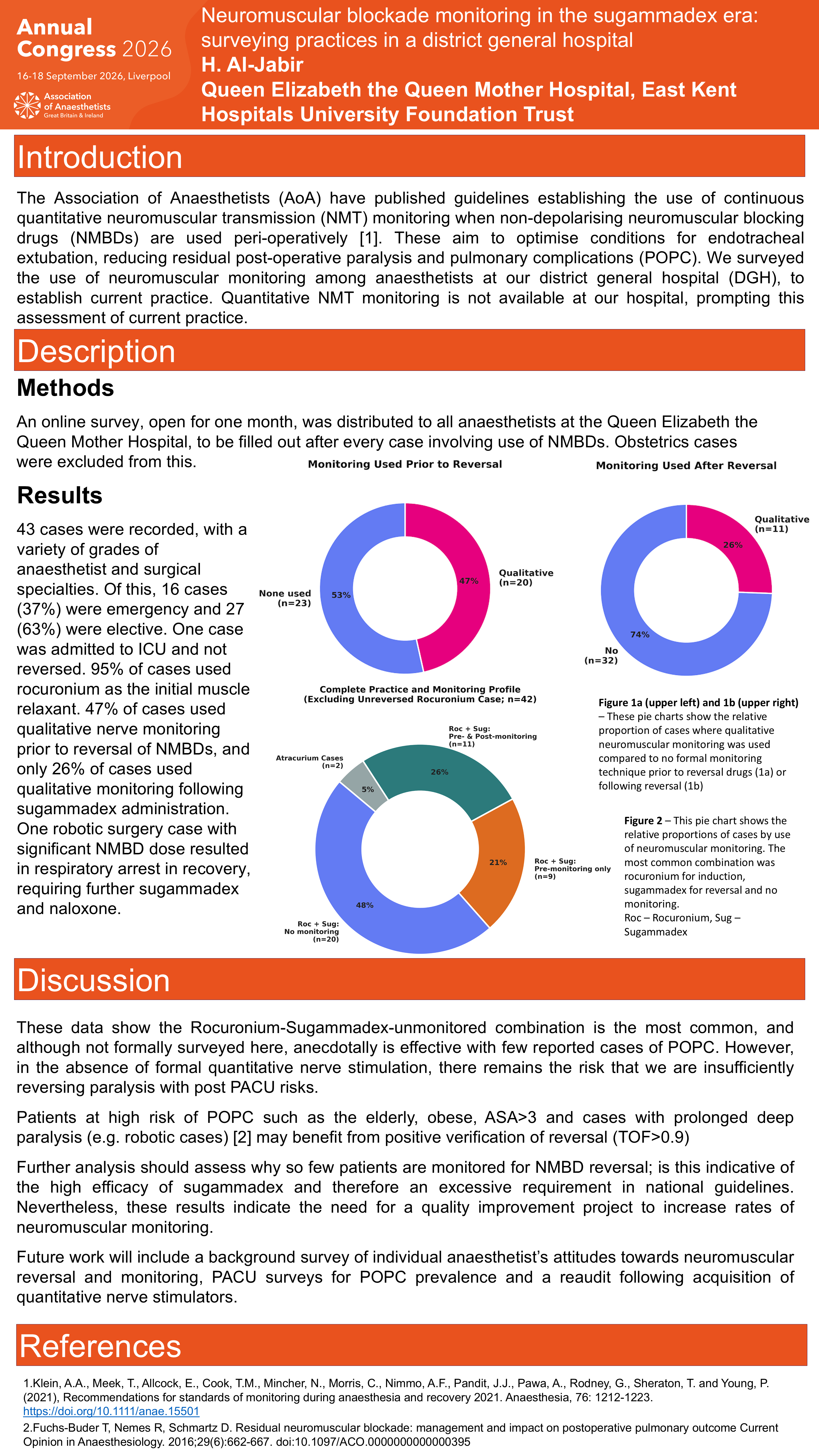
Poster no: 043
043
The Association of Anaesthetists has published guidelines establishing the use of continuous quantitative neuromuscular transmission (NMT) monitoring when non-depolarising neuromuscular blocking drugs (NMBDs) are used peri-operatively [1]. These aim to optimise conditions for endotracheal extubation, reducing residual post-operative paralysis and post-operative pulmonary complications (POPC). We surveyed the use of neuromuscular monitoring among anaesthetists at our district general hospital (DGH), to establish current practice.
Methods
An online survey, open for one month, was distributed to all anaesthetists at the Queen Elizabeth the Queen Mother Hospital, to be completed after every case involving the use of NMBDs. Obstetrics cases were excluded from this.
Results
Data were captured from 43 cases (63% elective, 37% emergency). Rocuronium was used for induction in 95% of cases, with sugammadex used universally for NMBD reversal. Of these, 47% used qualitative neuromuscular monitoring, vs 53% using no pre or post-reversal monitoring at all. 24% of consultant cases used some form of monitoring, compared to 43% of trainee grades.
All cases except one received 200mg of sugammadex, which corresponded to a mean dose of 2.66mg/kg (1.67 - 6.90mg/kg). Use of sugammadex was associated with non-significant bradycardia in 12% of cases.
There were two cases of inadequate reversal (4.7%). One robotic surgery case using sugammadex without monitoring resulted in a respiratory arrest two hours later, which resolved with use of further sugammadex and naloxone. A further case required additional reversal agent before extubation. In 40% of cases, the anaesthetist would be 'very likely' or 'somewhat likely' to use NMT if available.
Discussion
These data indicate ubiquitous use of the rocuronium-sugammadex-unmonitored combination in a DGH. This is partially explained by lack of universal NMT availability, but more comprehensively by individual attitudes towards NMBD reversal. The extremely high anecdotal efficacy of sugammadex has led to a shift in practice. Consequent questions can be raised about the need for mandatory NMT within this landscape or if targeted NMT should be used where POPC risk is high, e.g. prolonged deep neuromuscular blockade or the elderly.
Further surveys could focus on individual anaesthetists' attitudes towards omitting neuromuscular monitoring. Quality improvement projects may also be undertaken to increase rates of NMT, and assess rates of POPC.