

Poster no: 149
Poster no: 149
149
Nitrous oxide (N2O) is a greenhouse gas that has a significantly higher potential to cause global warming than CO2.
In Harrogate hospital anaesthetic department an audit conducted last year showed significant amounts of N2O wastage via leaky pipelines (around 270,000L). This demonstrated the potential for significant cost and environmental savings by decommissioning the nitrous oxide pipelines and switching to cylinder manifolds [1].
Following successful decommissioning of the pipelines, we reaudited clinical practice, cost and environmental savings.
Methods
As with the previous audit we studied the impact decommissioning of N2O pipelines has had on clinical practice and its benefits to the trust.
From the pharmacy department, we obtained the amount of N2O cylinders used.
A survey was conducted across members of the department about their usage of N2O via the new cylinder manifold.
A snap audit was conducted across all theatres over 48 hrs to capture N2O usage.
Results
Data from the pharmacy department showed that in over 4 months since pipeline decommission, the manifold cylinders have been used very sparingly, and none have needed to be replaced.
Upon inspection all 4 cylinders remain full.
This contrasted to 5800L of N2O previously used each week via the pipelines.
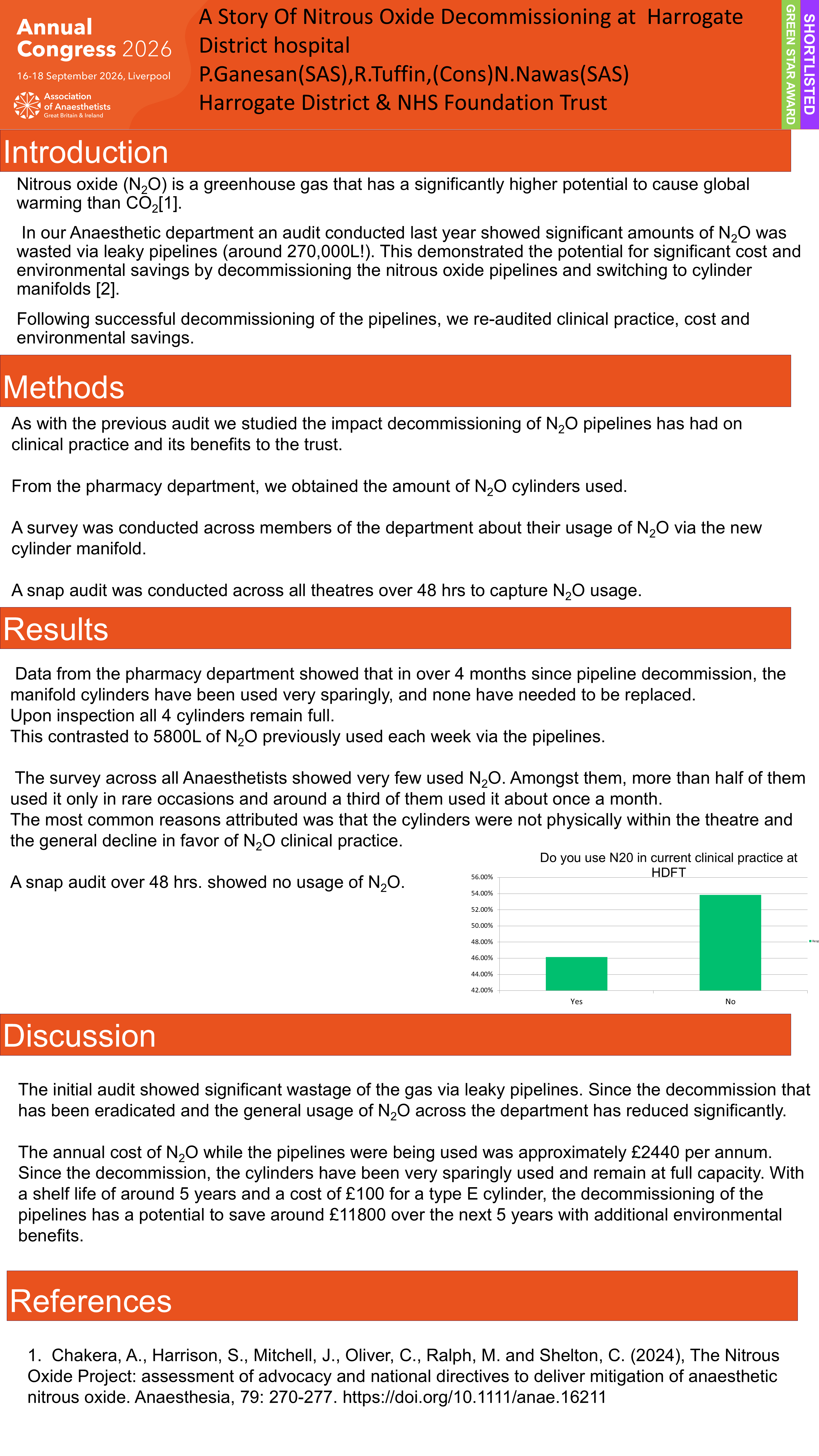
The survey across all anaesthetists showed very few used N2O. Amongst them, more than half of them used it only in rare occasions and around a third of them used it about once a month.
The most common reasons attributed was that the cylinders were not physically within the theatre and the general decline in favour of N2O clinical practice.
A snap audit over 48 hrs showed no usage of N2O.
Discussion
The initial audit showed significant wastage of the gas via leaky pipelines. Since the decommission that has been eradicated and the general usage of N2O across the department has reduced significantly.
The annual cost of N2O while the pipelines were being used was approximately £2440 per annum. Since the decommission, the cylinders have been very sparingly used and remain at full capacity. With a shelf life of around 5 years and a cost of £100 for a type E cylinder, the decommissioning of the pipelines has a potential to save around £11800 over the next 5 years with additional environmental benefits.