

Poster no: 073
Poster no: 073
073
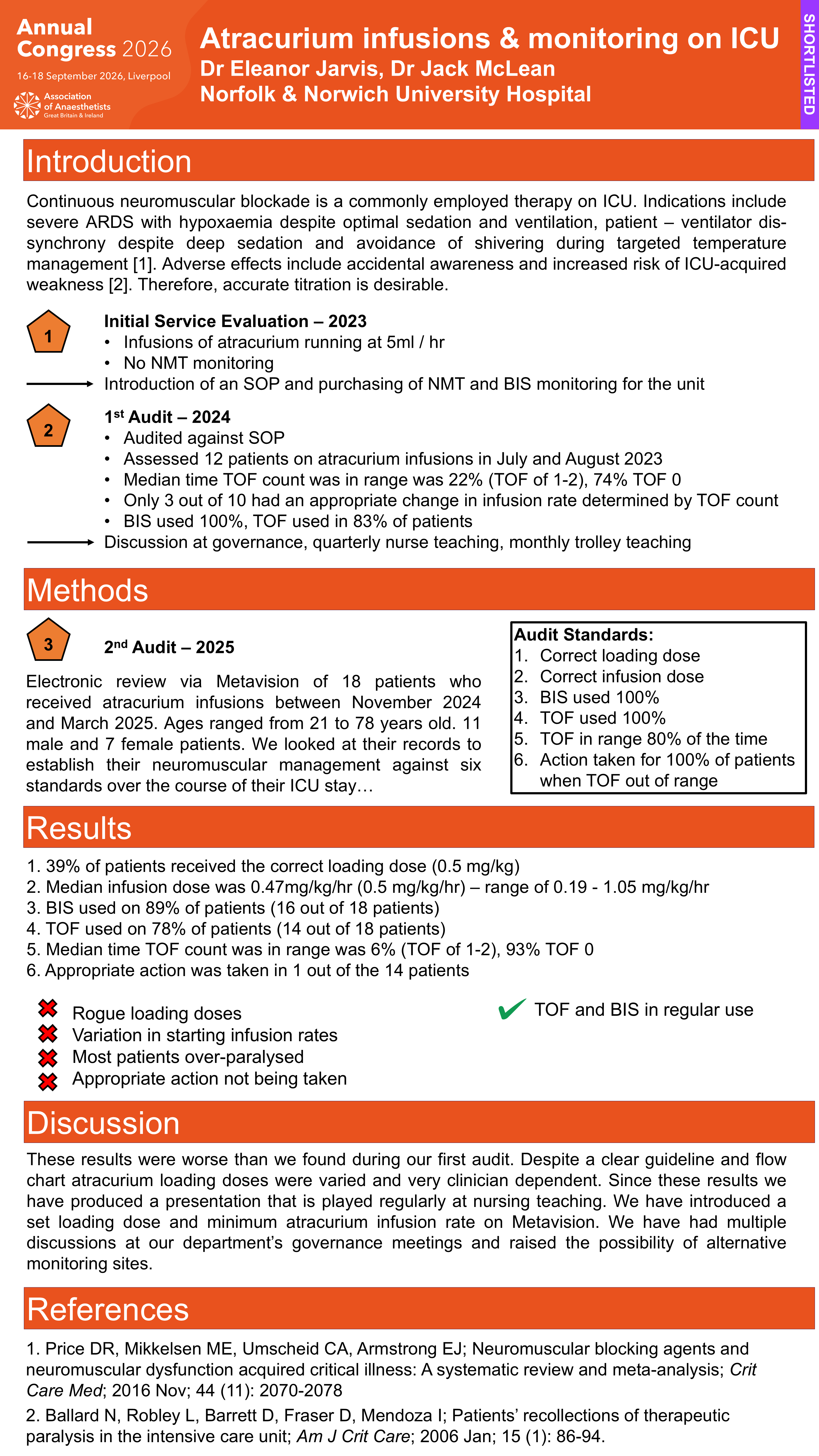
This was the second service evaluation in two years to assess the effectiveness and appropriateness of neuromuscular blockade in intubated patients in our intensive care unit (ICU). We looked at 18 patient’s ICU stay and determined how well their neuromuscular management matched our current guideline. Despite the majority having an EEG and TOF measurement, the median time that the patient’s TOF count was in range was 6.1%. 1 out of 14 patients who had TOF measurements had appropriate action taken when their measurements were out of range. We have since introduced a neuromuscular talk for the nursing staff, discussed this at length at our department’s governance meeting and have set a minimum rate for atracurium infusions. We are also in the process of considering alternative monitoring sites.
Method
Eighteen patients were identified by our hospital’s electronic review as having had atracurium infusions between November 2024 and March 2025. We looked at electronic records to establish their neuromuscular management against six standards over the course of their ICU stay.
Results
39% received the correct loading dose of atracurium. The median infusion dose was 0.47mg/kg/hr (our guideline produced prior to the first audit recommended 0.5mg/kg/hr). 89% had a quantitative EEG recorded and 78% had a quantitative train of four recorded. The median time that our patient’s TOF count was in range was 6.1%. It was below range in 92.6% of patients and above range in 0% of patients. Appropriate action of these values was taken in 1 out of 14 patients.
Discussion
We found that despite TOF and BIS being in regular use on the unit, the TOF count was not in range the majority of the time and most patients were over-paralysed. We also found that unfortunately appropriate action and reduction in these atracurium infusions was not occurring. These results were worse than we found during our first audit. Despite a clear guideline and flow chart which was produced after our first audit, atracurium loading doses were varied and very clinician dependent. Since these results we have produced a presentation that is played regularly at nursing teaching. We have introduced a minimum atracurium infusion rate. We have had multiple discussions at our department’s governance meetings and raised the possibility of alternative monitoring sites.
Acknowledgements
Norfolk and Norwich University Hospital Critical Care Unit