

Poster no: 142
Poster no: 142
142
Physical activity and lifestyle choices influence labour pain perception, analgesia requirements, and childbirth outcomes. However, the long-term impact of adolescent fitness on maternal health remains underexplored. This study aimed to examine whether adolescent physical fitness levels are associated with intrapartum outcomes and postpartum recovery among parturients receiving epidural labour analgesia.
Methods
This prospective observational study analysed data from 99 women delivering at National University Hospital, Singapore, between October 2024 and September 2025. Adolescent exercise frequency was categorised on a validated 5-point scale (1=never, 5=daily). Women with conditions contraindicating exercise or unable to recall exercise history were excluded. Exercise patterns were collected across three life stages. Primary outcomes included breakthrough pain, epidural re-siting ; secondary outcomes were length of stay and patient satisfaction. Groups were compared using the Kruskal-Wallis test for continuous variables and chi-square test for categorical variables, with significance set at p<0.05.
Results
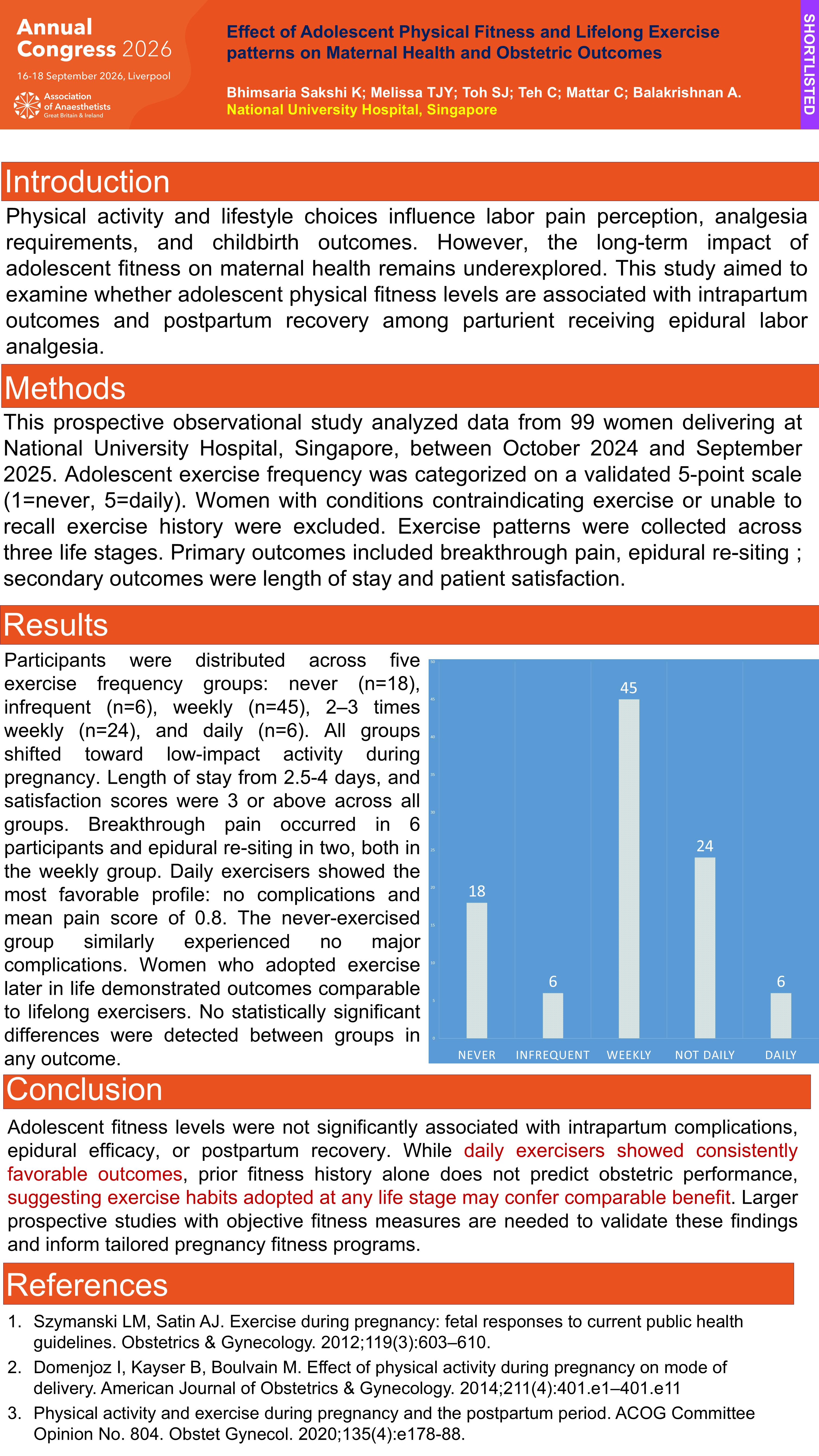
Participants were distributed across five exercise frequency groups: never (n=18), infrequent (n=6), weekly (n=45), 2–3 times weekly (n=24), and daily (n=6). All groups shifted toward low-impact activity during pregnancy. Length of stay from 2.5-4 days, and satisfaction scores were 3 or above across all groups. Breakthrough pain occurred in 6 participants and epidural re-siting in two, both in the weekly group. Daily exercisers showed the most favourable profile: no complications and mean pain score of 0.8. The never-exercised group similarly experienced no major complications. Women who adopted exercise later in life demonstrated outcomes comparable to lifelong exercisers. No statistically significant differences were detected between groups in any outcome.
Discussion
Adolescent fitness levels were not significantly associated with intrapartum complications, epidural efficacy, or postpartum recovery. While daily exercisers showed consistently favourable outcomes, prior fitness history alone does not predict obstetric performance, suggesting exercise habits adopted at any life stage may confer comparable benefit. Larger prospective studies with objective fitness measures are needed to validate these findings and inform tailored pregnancy fitness programmes.