
Poster no: 101
Poster no: 101
101
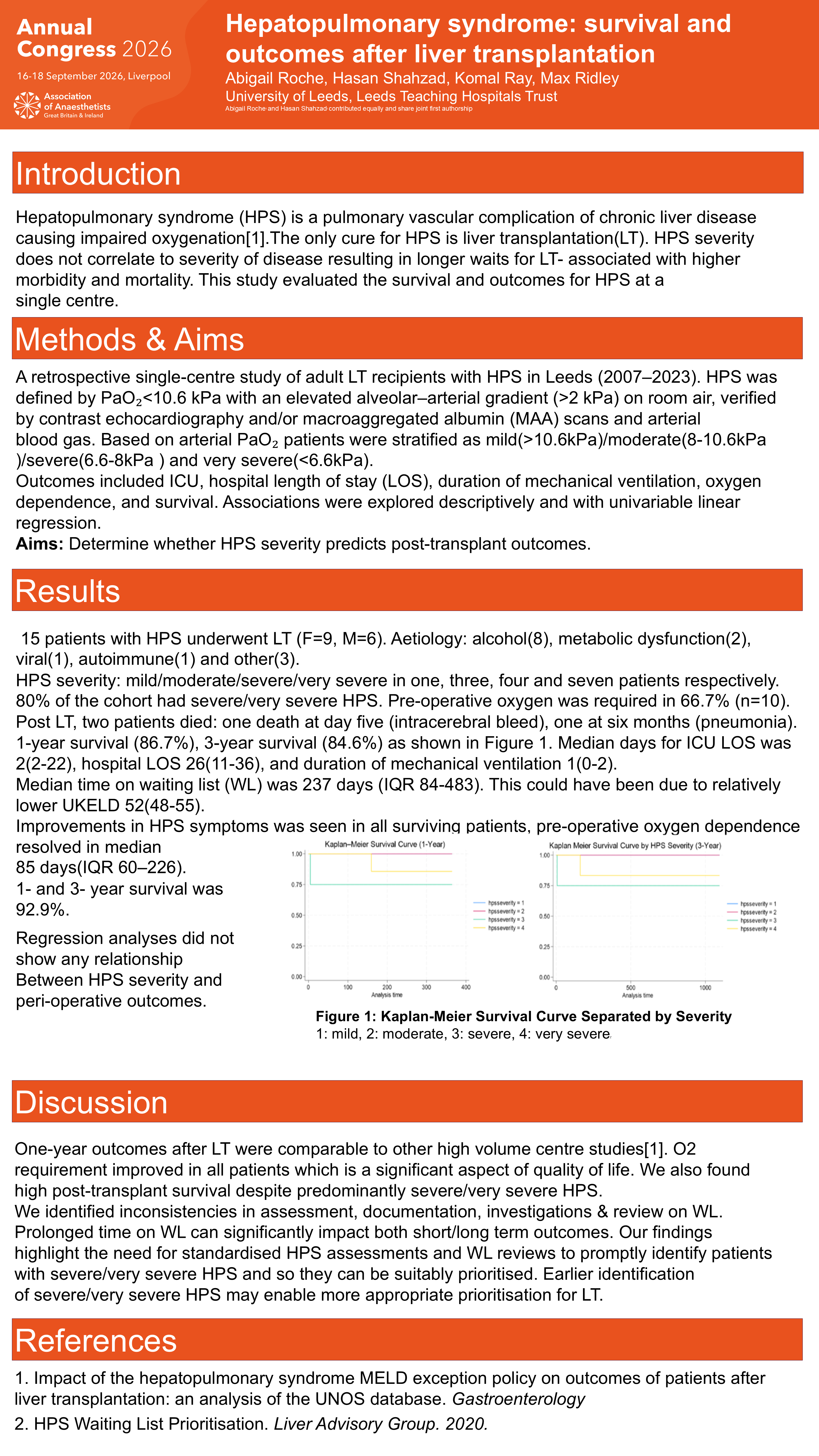
Hepatopulmonary syndrome (HPS) is a pulmonary vascular complication of chronic liver disease causing impaired oxygenation[1]. The only cure for HPS is liver transplant (LT). HPS severity does not correlate to severity of liver disease, resulting in longer waits for LT - associated with higher morbidity and mortality[2]. This study evaluated efficacy of LT, survival and outcomes for HPS.
Methods
A retrospective single-centre study of adult LT recipients with HPS in Leeds (2007–2023). HPS was defined by PaO₂<10.6 kPa with an elevated alveolar–arterial gradient (>2 kPa) on room air, verified by contrast echocardiography and/or macroaggregated albumin (MAA) scans and arterial blood gas. Based on arterial PaO₂ patients were stratified as mild(>10.6kPa)/moderate(8-10.6kPa )/severe(6.6-8kPa ) and very severe(<6.6kPa). Outcomes included ICU, hospital length of stay (LOS), duration of mechanical ventilation, oxygen dependence, and survival. Associations were explored descriptively and with univariable linear regression.
Results
15 patients with HPS underwent LT (F=9, M=6). Aetiology: alcohol(8), metabolic dysfunction(2), viral(1), autoimmune(1) and other(3). HPS severity: mild/moderate/severe/very severe in one, three, four and seven patients respectively. Pre-operative oxygen was required in 66.7% (n=10). Post LT, two patients died: one death at day five (intracerebral bleed), one at six months (pneumonia). 1-year survival (86.7%), 3-year survival (84.6%) as shown in Fig 1.
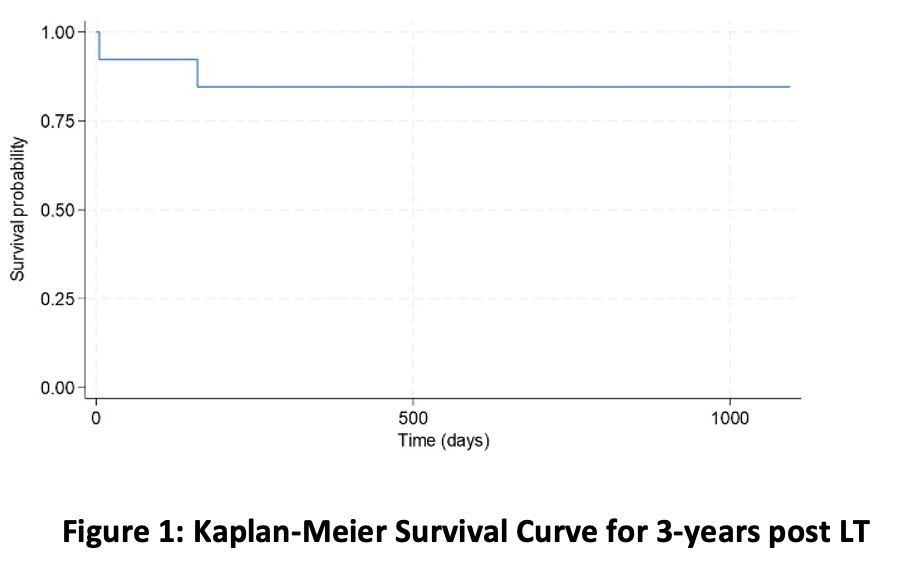
Figure 1
Median days for ICU LOS was 2(2-22), hospital LOS 26(11-36), and duration of mechanical ventilation 1(0-2). Improvements in HPS symptoms was seen in all surviving patients, pre-operative oxygen dependence resolved in median 85 days(IQR 60–226). Median time on waiting list (WL) was 237 days (IQR 84-483). This could have been due to relatively lower UKELD 52(48-55). Regression analyses did not show any relationship between HPS severity and peri-operative outcomes.
Discussion
One-year outcomes after LT were comparable to other high volume centre studies[1]. O2 requirement improved in all patients which is a significant aspect of quality of life. We identified inconsistencies in assessment, documentation, investigations & review on WL. Prolonged time on WL can significantly impact both short/long term outcomes. Our findings highlight the need for standardised HPS assessments and WL reviews to promptly identify patients with severe/very severe HPS and so they can be suitably prioritised.