

Poster no: 047
Poster no: 047
047
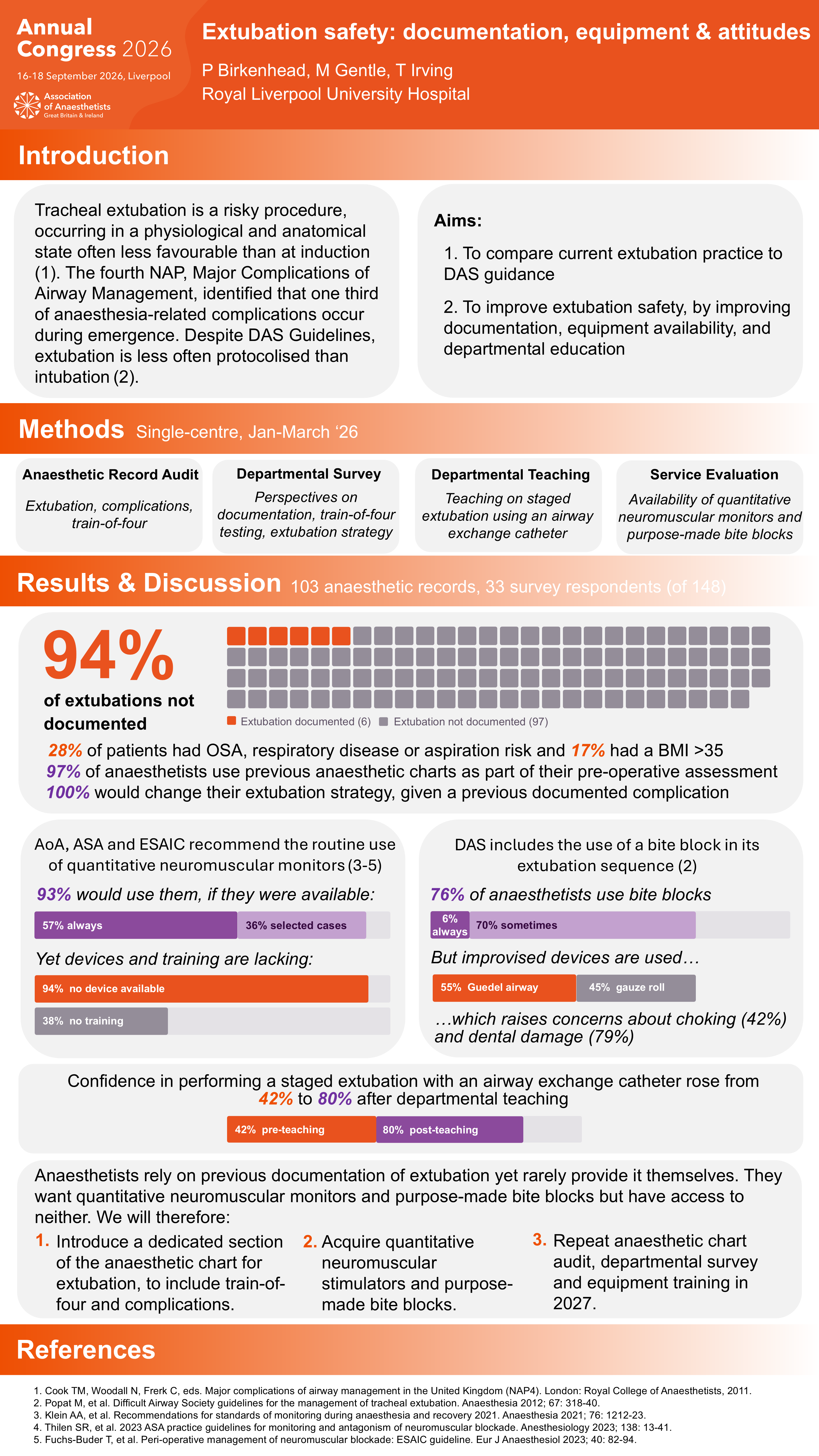
Extubation is an invasive procedure as highlighted in NAP 4 [1], occurring when patients are in a volatile physiological plane. The Difficult Airway Society published guidelines on extubation (2), emphasising its risk. However, extubation is often overlooked, increasing the risk of complications. The aim of this project was to assess current perspectives, compare practice with guidelines, improve extubation safety, documentation, and equipment availability.
Methods
A review of paper records was undertaken between January and March 2026. Data collected included demographics, operation (speciality, elective vs emergency), co-morbidities/BMI, intubation, extubation documentation (neuromuscular blockade, complexity, adjuncts, complications). An online survey was disseminated, collecting perspectives surrounding extubation documentation, equipment, and familiarity with high-risk strategies.
Results
103 patients were included. 29 suffered co-morbidities increasing extubation risk, BMI status included 17 patients >35, with 17 patients requiring RSI. The majority of intubations were undertaken with video (94%), adjuncts were required in 17%. Of 103 cases, 97 did not have documented extubations. Survey data was collected with 33 respondents. 97% searched to assess previous anaesthetic records, 100% agreeing they would change extubation strategy based on previous documented difficulty. 76% of respondents used bite blocks, oropharyngeal airway most commonly (45%), followed by gauze (39%). Both methods had concerns related to safety, 78% agreeing that purpose-made bite blocks should be available. Quantitative neuromuscular monitoring was used by 36%. The number one barrier to use was a lack of availability. Only 42% of respondents were confident in staged extubation.
Discussion
Survey data demonstrated the utility of documentation in enabling anaesthetists to predict and plan for difficult extubation. However, data suggests extubation is highly under-documented. Survey responses advocated purpose-made bite blocks and demonstrated a widely regarded concern for the use of existing methods. Quantitative neuromuscular monitoring was advocated by respondents despite its limited use. Based on results and feedback we have added a dedicated extubation section on our anaesthetic charts. Purpose-made bite blocks for wider use have been ordered. We have undertaken departmental training on quantitative nerve stimulators and device acquisition, and training on staged extubation.