

Poster no: 084
Poster no: 084
084
Correct syringe labelling is a recognised strategy to reduce errors in drug administration, particularly in anaesthetic and critical care environments where injectable drugs are administered with profound physiological effects.
The originial audit in 2012 [1] identified deficiencies in colour-coded syringe label availability and introduced various measures to address this including rationalised label ordering, revised stock levels, and laminated replenishment guidance. Re-audits in 2013 and 2016 tracked the early impact of these interventions; however, the long-term sustainability of these interventions cannot be assumed, as institutional memory, staff turnover, and operational pressures can erode established practices over time.
This re-audit examines whether the original 2012 interventions have been maintained many years on, whilst comparing findings against the previous re-audits to provide a longitudinal overview of syringe label availability across the hospital.
Methods
Using the gold standard established in the original audit in 2012 and the AAGBI guidance standard [2], we carried out a point in time spot check across anaesthetic areas to assess label and guidance laminate availability. Data was analysed using Microsoft Excel.
Results
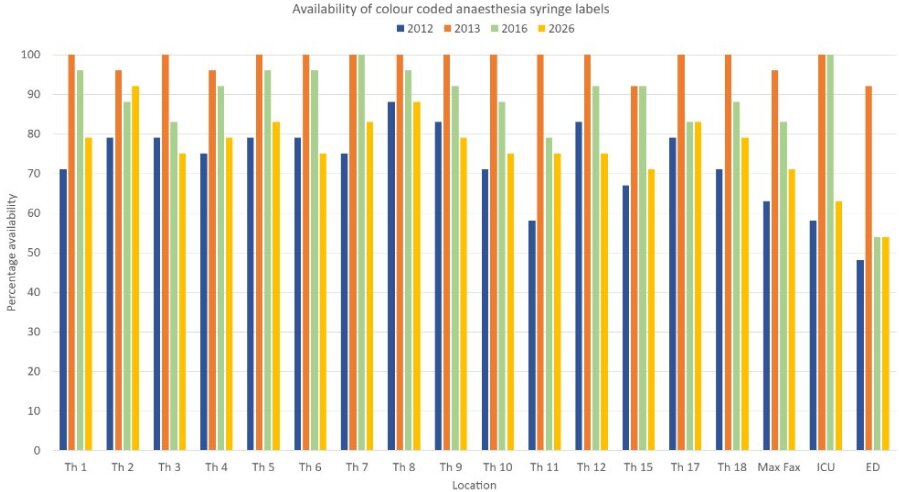
Our re-audit showed that availability of syringe labels in various parts of anaesthetic areas in the hospital was low (54-92%). This had fallen to compliance levels seen similarly in the original 2012 audit (46-88%) and significantly worse than the audit carried out in 2013 (92-100%) The guidance laminates were not present in any locations.
Discussion
This re-audit demonstrates that compliance with colour-coded syringe label availability has regressed to levels comparable to those recorded in the original 2012 audit. Whilst the 2013 re-audit confirmed that the corrective measures were highly effective in the short term, the results of this fourth re-audit suggest that their impact has mostly been lost to time with compliance now returning to pre-intervention baseline.
The absence of guidance laminates across anaesthetic areas is likely a key contributing factor. These laminates were central to the original intervention, providing point-of-use replenishment guidance for staff.
These findings were presented at our local clinical governence meeting where we highlighted the well-recognised challenge of sustaining quality improvement initiatives long-term without active maintenance.